

Worst BioWare Games: The Lowest-Scored One Didn’t Kill the Studio
Two days ago, on October 21, EA shut BioWare down. The next Mass Effect, in early development, is cancelled. Around 400 people lost their jobs across EA, roughly 50 of them at BioWare. The studio, incorporated in February 1995 by two Edmonton doctors and launched that May, posted a statement beginning “There is nothing easy about writing these words.”
Which means this keyword now has two different answers, and the gap between them is the whole story.
Ask which BioWare game reviewed worst and the answer is simple and has been for seven years. Ask which BioWare game did the most damage to BioWare and you get a different game entirely – one that reviewed perfectly respectably and was followed within months by the layoffs that cut the studio in half.
So let’s separate the two. The score ladder first, then the damage ladder, and then the thing that actually finished it, which was neither.
| Game | Year | Metacritic |
|---|---|---|
| Anthem | 2019 | 54 PS4 / 59 PC / 65 Xbox One |
| Mass Effect: Andromeda | 2017 | 71 PS4 / 72 PC / 76 Xbox One |
| Sonic Chronicles: The Dark Brotherhood | 2008 | 74 on DS |
| Dragon Age: The Veilguard | 2024 | 76 PC / 82 PS5 / 85 Xbox Series X |
| Dragon Age II | 2011 | 81 |
| Dragon Age: Inquisition | 2014 | 85 PC / 89 PS4 |
| Mass Effect 2 | 2010 | 96 |
That is the honest ladder, and it contains a surprise most coverage of this subject skips: Veilguard reviewed better than Andromeda on every platform, and on Xbox Series X it matched Dragon Age: Inquisition.
By Score Alone, Anthem Is the Floor
No argument to be had here. Anthem is BioWare’s worst-reviewed game, at 54 on PS4, 59 on PC and 65 on Xbox One, and it has held that position since February 2019.
What makes it the clearest case of “worst” is that it failed at the thing it was built to be. A loot shooter lives or dies on its endgame loop and its content cadence, and Anthem launched without a convincing version of either. It was not a good RPG that stumbled into a bad genre – it was a game whose core proposition did not function.
The instructive part is what happened next. BioWare survived Anthem by seven years. The studio shipped Mass Effect Legendary Edition in 2021 to scores of 86 to 90, then Dragon Age: The Veilguard in 2024, and continued working on a new Mass Effect until two days ago.
A 54 on PlayStation did not close BioWare. Which tells you review scores are a measure of a game’s quality, not a measure of what a game costs the people who made it.
The Worst BioWare Games by Damage Done Rather Than by Score
Dragon Age: The Veilguard arrived in October 2024 and reviewed respectably – 76 on PC, 82 on PS5, 85 on Xbox Series X. By the standards of any other studio that is a solid launch. By the standards of a developer whose back catalogue includes a 96, it was a disappointment, and commercially it fell short of what EA needed.
What followed is the part that matters. In January 2025, EA cut BioWare’s staff after Veilguard underperformed, taking the studio from more than 200 people to fewer than 100. Long-serving Dragon Age developers were among those let go as the remaining team was pointed entirely at Mass Effect 5.
Then, this week, that project and the studio went together.
So by the measure of institutional damage, the ladder reads almost backwards from the score ladder:
- Veilguard reviewed in the high seventies and eighties, and preceded the halving of the studio.
- Anthem reviewed in the fifties, and the studio continued for seven more years.
- Andromeda reviewed in the low seventies, and ended Mass Effect development for four years while the series went into a remaster holding pattern.
- Dragon Age II reviewed at 81 and damaged nothing structurally, despite being the most openly compromised production on this list.
EA’s own shutdown reporting names Anthem and Veilguard together as the games that fell short of expectations. Both are on the list. Only one of them reviewed badly.
Mass Effect: Andromeda Set the Pattern
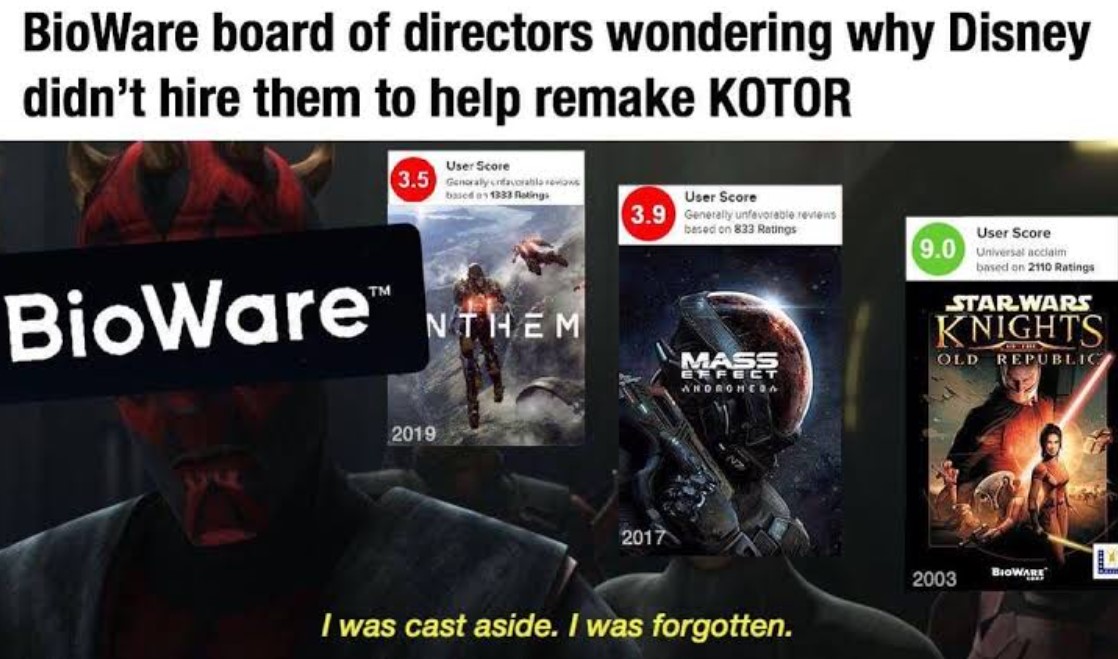
The 2017 entry is the one that established how this would go, and its scores – 71 on PS4, 72 on PC, 76 on Xbox One – undersell how significant it was.
Andromeda is where BioWare’s problems stopped being about individual games and started being about the studio’s ability to deliver. It followed a trilogy that peaked at 96 and closed at 93, and it landed twenty points below both. The series then produced nothing new for nine years – a remaster in 2021, a cancelled sequel in 2026 – which is a remarkable silence for one of the most valuable RPG properties in the industry.
If you are building a list of BioWare’s worst by consequence, Andromeda belongs high on it, because it is the point at which the studio stopped being treated as a safe bet.
The Older Misfires Nobody Counts
A fuller list than the usual three, because BioWare made games for thirty years and some of them are genuinely forgotten.
Shattered Steel (1996) was the studio’s debut, a mech game published by Interplay that landed to average reviews. Nobody holds it against them – it funded Baldur’s Gate – but it is objectively the shakiest thing with the BioWare name on it from a review standpoint.
Sonic Chronicles: The Dark Brotherhood (2008) sits at 74 on DS with a 6.2 user score, and it is the most interesting failure in the catalogue. Critics split almost evenly, praising the exploration and puzzle-solving while finding the RPG systems thin and repetitive. One review summarised it as not a bad game, just a disappointing one, which is the kindest possible description of a studio applying its own template to somebody else’s mascot.
Dragon Age II (2011) scored 81 and is the most honestly explained misstep in BioWare’s history, because its own developers have described what went wrong. It was built in roughly fourteen months, it reused environments heavily, and creative lead Mike Laidlaw has said the team “went too far” in streamlining the design. Fans found it too action-focused. A 14-month development cycle for a sequel to a 88-rated RPG was the actual mistake, and the game is the symptom.
Mass Effect Galaxy (2009) and Dragon Age Legends (2011) are the forgotten mobile and browser spin-offs, both now effectively unplayable, and both evidence of a studio taking on more than its headcount could support.
Star Wars: The Old Republic (2011) is harder to call a bad game – it is still running – but it was measured against World of Warcraft, and the studio’s own retrospective accounts acknowledge it did not reach that bar while attracting significant press attention for the scale of its spending.
What the Worst BioWare Games Had in Common
The most useful source on this is BioWare itself. A Game Informer oral history, originally published in the Andromeda issue and reposted on October 21 to mark the closure, contains the studio’s own account of its recurring failures.
Four admissions stand out:
- Overreaching relative to staff. Studio leadership acknowledged crunch and said BioWare “brought a lot of it on” itself by attempting more than its team size supported.
- Compressed schedules. Dragon Age II’s fourteen months is the clearest case, and the streamlining it forced is what players actually objected to.
- Shallow systems shipped anyway. Jade Empire’s combat was acknowledged as a weakness by its own leads, and its planned sequel was shelved after too much time had gone into it.
- No plan for backlash. On the Mass Effect 3 ending controversy, one developer said plainly: “We didn’t have a playbook for this”.
Read those together and the pattern is not incompetence. It is a studio consistently signing up for more than it could build, then absorbing the difference in crunch and compromise. Every game on the lower half of the score ladder has some version of that story behind it.
| Game | Review Verdict | Structural Consequence |
|---|---|---|
| Anthem | Worst-reviewed, 54-65 | Studio continued for seven more years |
| Veilguard | Respectable, 76-85 | Staff cut from 200+ to under 100 within months |
| Andromeda | Weak, 71-76 | Nine years without a new Mass Effect |
| Dragon Age II | Decent, 81 | None, despite the most compromised production |
| Sonic Chronicles | Mixed, 74 | None; a licensed side project |
| Shattered Steel | Average | Funded Baldur’s Gate |
The Thing That Actually Finished It Was Not a Game
This is the part the ranking cannot capture, and it needs saying plainly.
BioWare closed in a round of cuts affecting roughly 400 people and about 3% of EA’s workforce – a round that also cancelled an unannounced Sims project called Project Lotus and downsized the Skate team at Full Circle. In the staff letter, EA’s leadership described taking a hard look at the business and making deliberate choices to point talent and investment at its best opportunities. Battlefield, Apex Legends, the sports portfolio, the next Star Wars Jedi game and a new Iron Man game were all named as continuing to receive investment.
The context around that is the more complete explanation. EA agreed to a $55 billion buyout by Saudi Arabia’s Public Investment Fund about a year ago, went private roughly two months ago, and had told investors in March it planned to save around $700 million.
A single-player narrative RPG studio with a long development cycle and two underperforming releases in its recent history is a predictable casualty of that arithmetic. Anthem and Veilguard made BioWare vulnerable. A $700 million savings target at a newly private company made it expendable.
Which means the honest answer to “what was BioWare’s worst game” is that no single game did this. The studio’s worst-reviewed release was survivable. Its most damaging release was merely mediocre. What finished it was a portfolio decision made in a spreadsheet by owners who bought the company a year ago.
One More Thing the Scores Hide
A closing note on why the score ladder misleads people so badly on this subject.
Metacritic averages are platform-specific, and BioWare’s later games diverge wildly across platforms in a way its earlier ones did not. Veilguard spans nine points between its PC and Xbox Series X scores. Andromeda spans five. Anthem spans eleven. A single headline number for any of them is a rounding decision somebody made, which is how the same game ends up described as a flop on one site and a solid entry on another.
That matters for a list like this because it means the ordering of the bottom half changes depending on which platform you pull. On PC, Veilguard at 76 sits above Andromeda at 72. On Xbox, Veilguard at 85 sits above Dragon Age: Inquisition’s PC score. Pick your platform and you pick your narrative.
The only entry immune to that argument is Anthem, which is poor everywhere.
FAQ
What is the worst-reviewed BioWare game?
Anthem, from 2019, at 54 on PS4, 59 on PC and 65 on Xbox One – the lowest scores in the studio’s history.
Did Anthem cause BioWare’s closure?
No. BioWare continued for seven years after Anthem, shipping Mass Effect Legendary Edition and Dragon Age: The Veilguard in that period.
How did Dragon Age: The Veilguard review?
Better than most people remember – 76 on PC, 82 on PS5 and 85 on Xbox Series X, which is above Mass Effect: Andromeda on every platform.
Which game did the most damage to the studio?
By consequence, Veilguard. It underperformed commercially, and in January 2025 EA cut BioWare from more than 200 staff to fewer than 100.
When did BioWare close?
EA’s shutdown was reported on October 21, 2026, alongside the cancellation of the next Mass Effect and around 400 job losses across the company.
What was BioWare’s first game?
Shattered Steel in 1996, a mech game published by Interplay that reviewed averagely and helped fund Baldur’s Gate.
Is Sonic Chronicles really a BioWare game?
Yes. BioWare developed it for Nintendo DS in 2008, published by Sega, and it holds a 74 Metascore with a 6.2 user score.
Thirty Years, Two Ladders, One Spreadsheet
What the last two days have clarified is that “worst” was always doing two jobs in this question, and keeping them separate is the only way to answer it usefully. As criticism, the ranking is settled: Anthem at the bottom, Andromeda above it, Sonic Chronicles as the odd licensed footnote, Dragon Age II as the honest cautionary tale about fourteen-month schedules. Those are the games where the craft slipped, and in most cases the people who made them have said why.
As history, the ranking inverts. The game that cost BioWare the most reviewed in the eighties on one platform. The game that reviewed in the fifties cost it almost nothing institutionally. Quality and consequence turned out to be only loosely related, which is an uncomfortable thing to learn about an industry that publishes a number on every release.
And the final cause was neither. It was a $700 million savings target at a company that went private two months ago, applied to a studio that makes one expensive single-player RPG every five years.
Baldur’s Gate II still sits at 95. Mass Effect 2 still sits at 96. Nothing that happened this week changes either number.
P.S. Going to replay a BioWare classic this weekend? Share this, bookmark it, and pick the one with the 96 – and if creative or commercial collaboration brought you here, the T-Minus team is one message away.