


The Blood of Dawnwalker Guide to Surviving Your First Week in Vale Sangora
So here’s what happened. Rebel Wolves dropped their debut RPG on September 3, and within about six hours my Steam friends list turned into a graveyard of people staring at an hourglass icon, terrified to click anything. That’s the game. That’s the whole experience in one sentence. The Blood of Dawnwalker gives you 30 days and 30 nights to save Coen’s family from a vampire lord called Brencis. Not “30 days but the plot waits for you.” Actually 30. The clock is the villain here, more than any boyar with fangs.
And look – the critics agree it works. It landed around 83 on Metacritic and roughly 85 on OpenCritic with the “Mighty” badge. Steam’s been rougher, hovering in the low 70s positive, mostly because the PC build stutters like an old CD drive. We’ll get to that. But the design? The design is genuinely sharp.
This The Blood of Dawnwalker guide is built around one idea: every single thing in this game costs you something, and knowing the exchange rate early is the difference between a run that ends in a rescue and one that ends with a very quiet epilogue.
What Actually Eats Your Clock (and What Doesn’t)
Here’s the good news that nobody tells you in the first hour. Walking around is free.
Seriously. Exploring Vale Sangora, climbing rooftops, reading notes, poking at a locked door, fighting a random patrol of Brencis’ goons – none of that spends a segment. Time only moves when the game asks you to commit. You’ll see a little hourglass on the option, usually with a number attached.
Each day has eight segments. Each night has eight. That’s 480 total, and there is more content in this valley than 480 segments can cover. By design.
| Action | Costs Time? | Notes |
|---|---|---|
| Roaming, scouting, looting | No | Scout hard before you commit to anything |
| Regular combat encounters | No | Farming enemies at night is free blood |
| Main and side quest steps | Yes | Cost shown before you accept |
| Certain dialogue branches | Yes | Watch for the hourglass on the line itself |
| Learning skills and training | Yes | This one catches everybody |
| Resting or deliberately waiting | Yes | Sometimes worth it to flip day into night |
| Climbing Scouting Towers | No | Night only, but free – do them all |
That “learning skills costs time” row is the one that stings. You level up, you’ve got points burning a hole in your pocket, and then the game charges you hours to actually train the thing. So the question stops being “can I afford this skill” and becomes “is this skill worth a chunk of my rescue window right now?”
Honestly, that reframing is where the game clicked for me.
The Prologue Mistake That Follows You for 30 Days
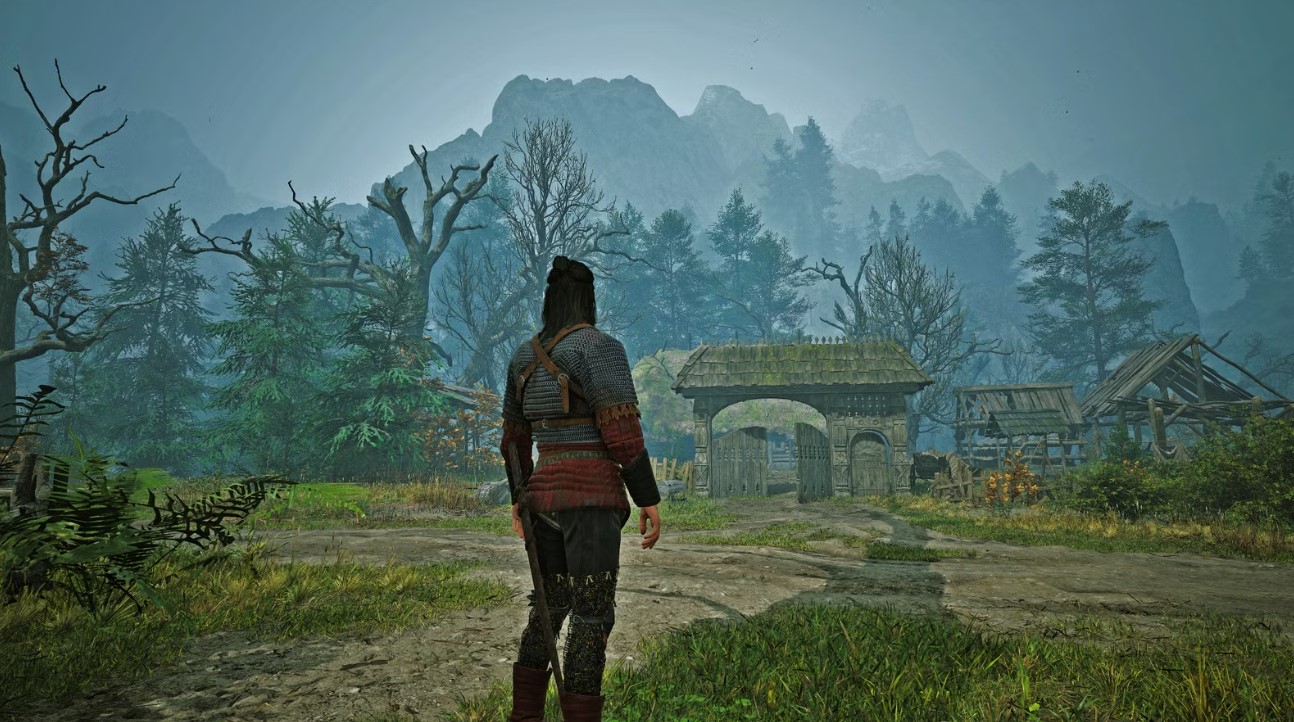
Before you’re loose in the valley, there’s a stretch in Laslea where Coen’s mother Esme is sick and you’re asked to prepare medicine with a village healer. Get the recipe wrong and she doesn’t survive the opening. That outcome sticks. All the way to the epilogue.
There’s no do-over, no “she was just injured” retcon. It’s a quiet little test tucked into the tutorial, and plenty of players sailed past it without realizing what they’d just decided. Take the extra minute. Read the ingredients.
Same principle applies to named NPCs generally. If someone has a name floating over their head, they’re probably load-bearing for a questline somewhere. Killing them – or feeding on them at night when Coen’s hungry – can silently delete content you never knew existed.
Two Coens, Two Rulebooks
This is the part where a lot of newcomers get stubborn and try to play both halves the same way. Don’t.
By day Coen is human. He’s got a sword, he’s got Witchcraft, and he creates openings through defense. The combat is directional – enemies telegraph an attack with an arrow, you match that direction and block just before impact for a Perfect Block. Nail it and you get a free window to counter.
If the directional stuff feels like patting your head while rubbing your stomach, there’s Omniblock. It auto-matches the direction for you. The catch is that it drains stamina, while a clean manual block costs nothing. There’s a Swordmastery perk that trims the cost, and a later upgrade that turns a badly aimed manual block into an Omniblock anyway, which is basically training wheels you eventually stop noticing.
By night Coen is a vrakhir, and everything inverts. Now you create openings through movement. Enemy swings horizontally? Dodge into the strike at the last second for a Perfect Dodge – costs zero stamina, opens them right up.
And here’s a thing early players miss: your claws often out-damage the rusty swords you’re finding in the first few regions. Claw up.
- Red skull instead of an arrow means unblockable – stop trying to be clever and dodge.
- Voracious Bite damages and heals at the same time, so it’s your night lifeline.
- Shadowstep plus Plane Shift is your traversal combo for towers, cliffs and rooftops.
- Witchcraft only fires during the day, Vampirism only at night, Swordsman abilities work always.
- Abilities need Activation Charges, which you earn by fighting cleanly rather than mashing.
One more thing on healing, because it trips people up constantly. Human Coen does not regenerate. Carry food. Fruit Juice and Moldovan Red Wine also hand you stamina regen on the side, which is quietly excellent. Vampire Coen heals by drinking – from enemies, from animals, from blood vials in your quick slots.
And if your vampiric health drops to its last segment at night, Coen gets Hungry. Walk into a conversation like that and he might drain the person he’s talking to. A friend. A quest giver. Someone you needed. So top up before anything narratively important, yeah?
Gear-wise, the game keeps separate day and night presets and swaps them automatically at dusk and dawn. Stop asking “is this armor better.” Ask “better for which Coen.”
The Blood of Dawnwalker Guide to Corruption, Infamy and the Other Meters
Three meters run in the background and they measure completely different things. Mixing them up is the fastest way to build a Coen who’s strong at the wrong hour.
| Meter | What It Tracks | How It Grows | What It Costs You |
|---|---|---|---|
| Corruption | Coen’s slide toward vampirism | Drinking blood, feeding often | Colors the story, but opens deeper Vampirism perks |
| Infamy | How much of a threat you are to Brencis | Wrecking camps, sabotage, killing his forces | Triggers Edicts – checkpoints, tougher patrols, higher prices |
| Anger Levels | How annoyed each boyar is with you | Disrupting that specific boyar’s operations | Eventually opens a quest to confront them directly |
Corruption is the interesting one, because it looks like a morality bar and isn’t. Mechanically, it’s a gate. Most of the good Vampirism perks won’t sell to you until Corruption is high enough, skill points or not. Endless Hunger – the one that boosts vampire health – is an early priority precisely because it keeps you out of Blood Craving territory.
So refusing to feed isn’t the “pure” run, it’s the weaker run. You just have to be at peace with what it does to Coen’s arc. Animals and hostile soldiers are consequence-free snacks, by the way. Farm the woods.
Infamy cuts the other direction. Every threshold you cross, Brencis issues another Edict and the valley gets meaner – more troops on roads, more checkpoints, merchants gouging you. But hammering the boyars raises their Anger, and enough Anger opens the door to taking one of them off the board before the finale. Pain now, easier ending later.
There’s no morality score telling you which was correct. That absence is deliberate, and it’s the best thing about the game.
Skills, Manuals, and Why Your Tree Is Locked
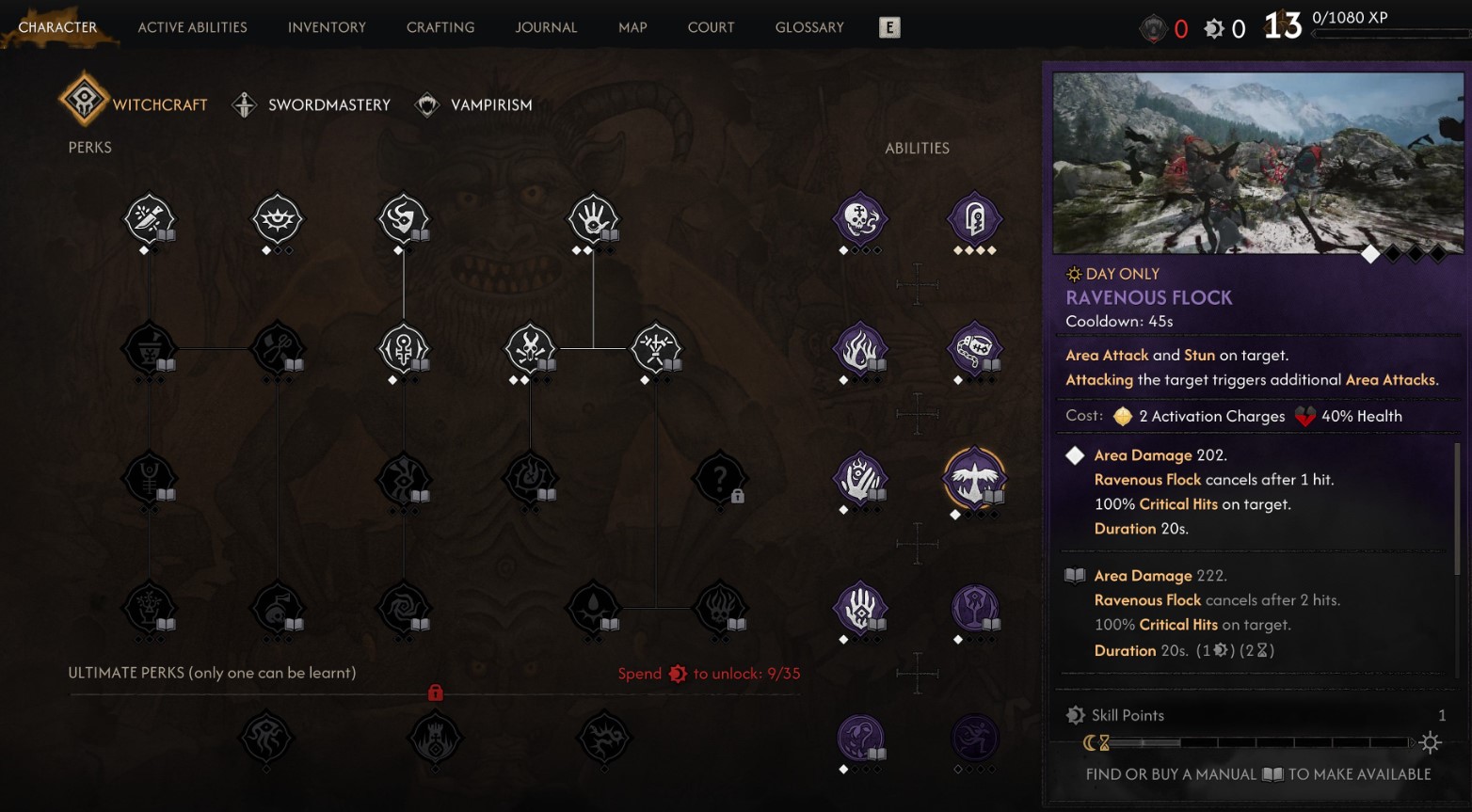
Three trees: Swordmastery, Witchcraft, Vampirism. Skill points come from leveling. Simple enough.
Except points alone won’t get you everything. A lot of abilities – and most of the deeper upgrades – need a matching Manual before they’ll even appear as purchasable. Manuals turn up in exploration, quest rewards and merchant stock. Finding one doesn’t teach you the move; it just makes the move available to learn.
If a chunk of your tree looks permanently greyed out, you’re not underleveled. You’re missing paper:
- Endless Effort first – more stamina helps attacking, dodging, sprinting, and Omniblock alike.
- Fleet of Foot second – cheaper dodges, and it works in both forms.
- Endless Hunger for night survivability, which doubles as Blood Craving insurance.
- Chase the Charge Manual through the Like Father, Like Son questline.
- Bear Trouble hands over the Ravenous Flock Manual, a real one for Witchcraft builds.
Emptying your stamina bar entirely makes Coen Fatigued – slower swings, weaker hits, no dodge when the red skull shows up. Which is why raw damage nodes are a trap early. A fast, mobile Coen out-damages a big-numbers Coen who’s constantly gassed.
Routing the Valley Without Wasting a Single Night
After the prologue the game opens completely. You can march straight at Brencis’ castle on day two if you want. It’s a legitimate route and it goes about as well as you’d expect.
The same path runs through his three boyars – Ambrus, Bakir and Xanthe – via Court Activities. There are 41 of them across the valley: 14 tied to Ambrus, 12 to Bakir, 15 to Xanthe. Community consensus after launch week is that Ambrus first, Bakir second, Xanthe third gives the smoothest power curve.
Crucially, you don’t need to clear every activity. You need enough to max that boyar’s Anger. Anything beyond that is time you’re spending for flavor, which is fine if you’ve got it and awful if you don’t.
Two side chains punch above their weight. A Pilgrimage for Power sends you chasing wind chimes to Uriash’s sacred sites and pays off for Witchcraft. Forge It Anew rebuilds St. Mihai’s Silver Sword from three shards scattered around Maragir Wealds, Rockfalls and Xanthe’s turf – one of the standout legendary weapons in the game.
Then there’s the Sanzhani. These are little moth fairies dotted across the map, and each one lets Coen send a letter to his imprisoned sister Lunka. Finish all five – Good Home, Pearly and Precious, Tiny Dancer, Come Hither, and Burrow Sorrows – and you earn an achievement plus one extra day before the coronation.
An entire extra day. Nothing else in the game gives time back. Do these.
Last routing note: Scouting Towers. They’re night-only because you need vampiric traversal to reach the top, and climbing one lights up nearby points of interest across the surrounding area. Hit every tower the moment you enter a new region, and you’ll plan the next few days with actual information instead of vibes.
The Blood of Dawnwalker Guide to Taming the Launch Build
Alright, the awkward part. This thing runs on Unreal Engine 5 with Lumen doing heavy lifting, and the launch build is rough. Stutter, shader compilation hitches, crashes. Steam reviews reflect it.
Rebel Wolves moved fast, at least. Hotfix 1.0.2 landed within a day, fixing a Farkas dialogue blocker, a tutorial section where Lunka could wander off and get stuck, a blacksmith crafting issue in Briar Sloughs, plus controller dead zone and sprint input problems on PC.
The studio’s said more optimization work is coming:
- Run fullscreen, not borderless or windowed – this alone kills a lot of the stutter.
- Update your BIOS if you’re crashing during shader compilation.
- Grab current NVIDIA or AMD drivers before your first session.
- PS5 pad users on PC: remapping isn’t in the options yet, so plan around it.
- Console players want the 60fps performance mode from the day-one patch – Series S stays at 30.
The difficulty presets are your other pressure valve. Story, Fair, Challenging and Duelist, and you can switch mid-run. You can also tune individual sliders: enemy health, damage, aggression, the Perfect Block window, auto-blocking. If the directional system is fighting you while the frame rate is also fighting you, widening the block timing is not cheating. It’s self-defense.
FAQ
How long is a full playthrough?
Most players are landing somewhere between 50 and 70 hours for a run that engages with the side content properly.
Does the 30-day limit mean a game over?
No. The story continues; it just continues without your family. It’s an ending, not a fail state.
Can I finish everything in one run?
Nope. There are more time-consuming quests than segments in the calendar. That’s the entire point of the design.
Is exploring really free?
Yes. Travel, scouting, looting, and ordinary fights don’t touch your segments. Only committed actions with the hourglass icon do.
Should I feed on people to raise Corruption?
Animals and hostile soldiers give you Corruption without narrative fallout. Save the risky feeding for when you actually want that story.
Which boyar should I go after first?
Ambrus, then Bakir, then Xanthe is the order most of the community settled on during launch week.
Is it worth playing right now or waiting for patches?
If you’re here for story and atmosphere, play now. If jank ruins games for you, give it a patch cycle or two.
Go Make Some Choices You’ll Regret
Here’s why it matters. Most open-world RPGs quietly promise you can have everything if you’re patient enough. Rebel Wolves said no, and that single refusal makes an ordinary side quest feel like a decision.
You’ll finish your first run with a list of things you never saw. Someone you didn’t save, a boyar you never touched, a sword you left in three pieces. That list is the game working exactly as intended – and it’s the best possible reason to start a second one.
Now go on. The sun’s going down.
If this breakdown saved you a few precious time segments, pass it along – a share on X, Reddit or your guild Discord costs you nothing and helps our small team keep writing guides instead of chasing algorithms. Bookmark it too, because you’ll want the Corruption and Infamy tables again around day twelve when the Edicts start biting. And if you’re after creative or commercial collaboration, write to the T-Minus team directly – we answer every message, usually faster than a hotfix.