


GTA 6 Criminal Profile: Five Things Everyone Gets Wrong
There’s more misinformation circulating about this system than almost anything else in GTA 6, and most of it comes from a reasonable place: the preview coverage written months ago described a system that doesn’t quite match the one that shipped. Level names have changed. Assumptions about what it tracks were wrong. And the thing most people think is the headline feature may not actually be in the game.
So rather than another list of profile tiers, here’s what’s genuinely true about the Criminal Profile, organised around the five things people are getting wrong today.
First, What the System Actually Is
The Criminal Profile is a long-term behavioural tracker. It runs quietly in the background across your whole playthrough, and Jason and Lucia each have their own, tracked completely separately. Playing Jason as a careful operator has no effect on Lucia’s profile whatsoever.
What it measures isn’t whether you commit crimes – this is Grand Theft Auto, that’s the premise. It measures how you commit them. Clean, efficient, minimal force in one direction. Escalation, collateral damage, and unnecessary killing in the other.
Rockstar North co-studio head Rob Nelson told IGN directly that it isn’t a copy of Red Dead Redemption 2’s honor system, and that it runs separately from Jason and Lucia’s relationship.
Now the misconceptions.
Myth 1: It’s a Morality Meter
It isn’t, and this is the distinction the system is built around.
Red Dead Redemption 2’s Honor meter asked whether you were a good person. The Criminal Profile asks what kind of criminal you are. Those are different questions, and the second one has no “correct” answer.
A Professional isn’t morally superior to a Psycho. A Professional is a competent operator who does the job and leaves. A Psycho is someone for whom the job is secondary to the chaos. Both are criminals; the game isn’t telling you one is better.
There’s also no persistent on-screen bar nagging you about it. The system doesn’t nudge – it observes.
Myth 2: It’s a Kill Counter
This is the most persistent misunderstanding, and the evidence against it is striking.
One launch reviewer finished their run at Professional despite 300+ kills, including dozens of police officers.
Sit with that. Three hundred bodies, and the game still classified them as a clean operator. Which tells you the system weighs context far more heavily than volume.
What the profile actually cares about:
- Anything a mission forces you to do is ignored. If the script demands violence, that’s not on you.
- Genuine self-defence is ignored. Responding to a threat isn’t escalation.
- It reacts to force beyond what the moment required. That’s the whole test.
So killing a dozen police during a mission shootout where they’re actively shooting at you registers differently from executing a civilian who was running away. The system is asking whether the extra violence was necessary, not counting corpses.
Myth 3: The Levels Are Professional, Aggressive and Shattered
This is where preview coverage has caused real confusion, because the names changed.
Pre-launch articles – many still ranking – list the states as Professional, Aggressive, Violent, Psycho and Shattered. Some describe four main states rather than five.
The levels in the shipped game are:
| Level | Icon Colour | How You Get There |
|---|---|---|
| Professional | Yellow | Avoid violence unless threatened; stay undetected |
| Hardened | Orange | Willing to kill when needed, even if detected |
| Violent | Purple | Kill police and civilians, ignore non-lethal options |
| Psycho | – | Murder defenceless civilians, kill many police, kill animals |
| Irredeemable | – | Remain a Psycho for too long |
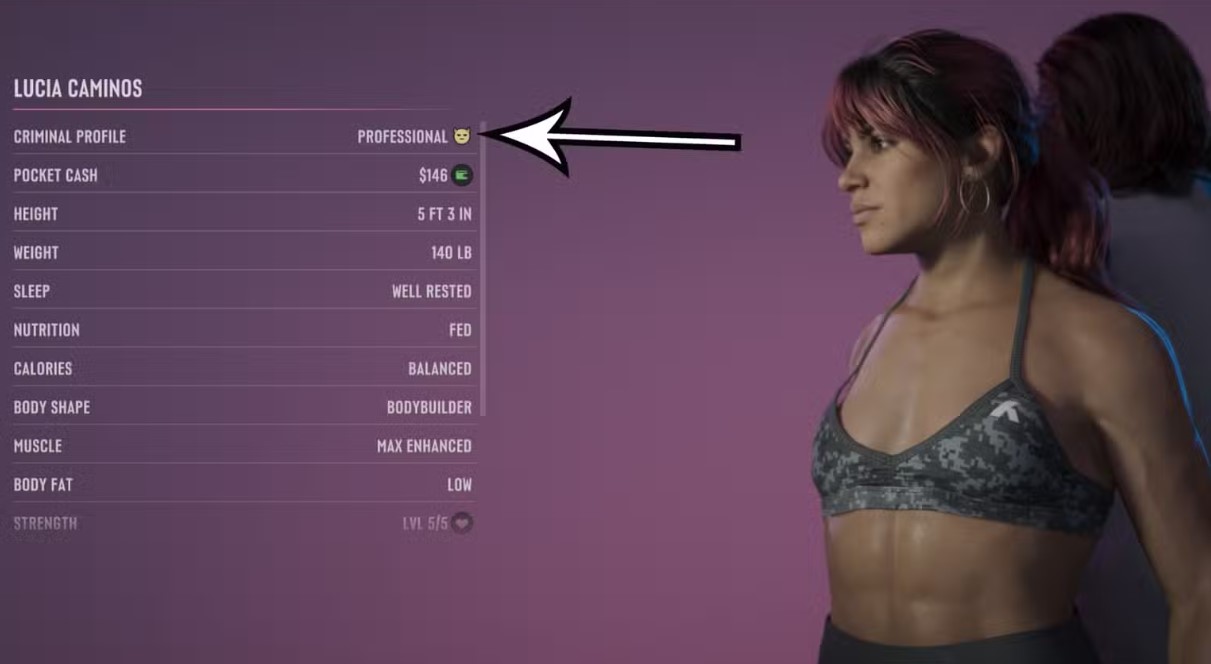
They’re displayed as “face with horns” emoji-style icons, which is a nicely sardonic touch.
Hardened is the neutral middle ground, sitting between Professional and Violent. Irredeemable is the end state, and it behaves very differently from the others – more on that shortly.
If a guide tells you about “Aggressive” or “Shattered,” it was written before launch.
Myth 4: It Doesn’t Affect Gameplay
Partly true, partly very wrong – and the part that’s wrong is the interesting bit. The GTA 6 Criminal Profile changes how you earn Focus, the game’s slow-motion ability. Each tier rewards a different playstyle:
| Profile | What Increases Your Focus |
|---|---|
| Professional | Thoughtful actions and non-lethal incapacitations |
| Hardened | Thoughtful actions and non-lethal incapacitations |
| Violent | Headshots |
| Psycho | Headshots |
That’s a genuinely clever bit of design. Rather than punishing you for playing violently, the system reconfigures itself to reward whichever approach you’ve actually adopted. A stealth player charges Focus by taking people down quietly; a violent player charges it by landing headshots.
It reinforces your chosen style instead of telling you one is correct.
There are police consequences too. At Psycho or Irredeemable, cops are more likely to fire on sight, and at Psycho, surrendering to police is no longer an option. The game stops treating you as someone who might come quietly.
Beyond Focus and police behaviour, though, the direct mechanical impact is limited. PowerPyx’s assessment after launch is that it’s primarily a statistics tracking tool. Which brings us to the big open question – but first, the one that’ll catch people out.
Myth 5: You Can Always Climb Back
For four of the five levels, yes. You can move up and down freely between Professional, Hardened, Violent, and Psycho throughout the game. Behave better, and the profile improves. Irredeemable is permanent.
If you stay at Psycho for too long, the profile tips into Irredeemable, and that’s the end of it. The icon cracks as you escalate beyond Psycho, and when it shatters, the system stops tracking your actions altogether. There is no route back. Nothing you do registers afterwards.
This is a point of no return that the game does not warn you about in advance, and it’s permanent for that character for the rest of the playthrough.
Whether that matters depends entirely on whether you care about the profile. If you’re playing a deliberately unhinged run, shattering the meter is arguably the goal. If you wanted to see what the system does across different tiers, you’ve locked yourself out.
Worth knowing before you spend an evening killing pets.
Where to Check Your GTA 6 Criminal Profile?
Two ways, both quick:
- In the character menu. Select a character and the current profile rating displays at the top. Since Jason and Lucia have separate profiles, check both.
- During gameplay. Hold Right and the criminal profile icon appears in the bottom right of the screen.
That second one is worth building into your habits, because the profile shifts gradually and you won’t otherwise notice movement until it’s already happened.
What Actually Moves the Needle
Collected from launch coverage and the Extended Look, here’s what the system responds to.
Pushing you toward Professional:
- Efficient robberies – in, done, out.
- Not escalating situations that didn’t need to escalate.
- Clean getaways without a trail of bodies.
- Non-lethal takedowns and incapacitating rather than killing.
- Staying undetected while committing crimes.
- Destroying evidence of your crimes.
- Feeding stray animals and petting dogs – genuinely tracked, genuinely positive.
- Putting trash in garbage cans, which is the funniest entry on any list in this game.
Pushing you toward Psycho:
- Unnecessary violence beyond what the moment required.
- Killing witnesses rather than escaping them.
- Killing police and civilians outside of forced or defensive situations.
- Killing pets and defenceless animals.
- Ignoring non-lethal options when they’re available.
The pattern should be clear: the system is watching whether you reach for more force than the situation needs. Everything else is noise.
The Story Question Nobody Can Answer Yet
Here’s the genuine tension in the coverage, and I’d rather flag it than pretend it’s settled.
- Pre-launch previews said the Criminal Profile affects the story. Reporting built on Edge magazine’s hands-on claimed Rockstar had confirmed the profile changes how the narrative unfolds, with the implication that two players could have noticeably different experiences.
- Post-launch assessments are more muted. PowerPyx, working from the released game, describes it as mainly a statistics tracking tool with Focus and police aggression as the only direct gameplay impacts.
Both can be partly right. Narrative consequences could be subtle – altered dialogue, different NPC reactions, changes that only become visible on a second playthrough with the opposite profile. A guide writer finishing the story once wouldn’t necessarily see them.
Or the preview framing may simply have oversold it.
Nobody has a definitive answer on launch day, because confirming it requires multiple full playthroughs at different profile levels. Expect the community to map this over the coming weeks. Until then, treat “it changes the story” as an open claim rather than an established fact.
GTA 6 Criminal Profile: How to Stay Professional
If you want the clean-operator run, the approach is more specific than “don’t kill people”:
- Scout before you commit. Detection is what forces escalation, so going in unseen prevents most profile damage before it happens.
- Take the non-lethal option when it exists. Incapacitating counts positively; the game notices you had a choice.
- Don’t clean up witnesses. Escaping them is better than removing them.
- Let missions do what missions do. Forced violence doesn’t count against you, so don’t play scripted sequences timidly.
- Defend yourself freely. Genuine self-defence is ignored by the system.
- Pet the dogs. It sounds like a joke and it is genuinely tracked.
The Focus reward loop makes this self-reinforcing. Play quietly, charge Focus through quiet takedowns, which makes the next quiet takedown easier.

FAQ
What is the Criminal Profile in GTA 6?
A behavioural tracking system that rates what kind of criminals Jason and Lucia are based on how they commit crimes rather than whether they commit them. Each character has a separate profile.
How many Criminal Profile levels are there?
Five: Professional, Hardened, Violent, Psycho, and Irredeemable. Older previews using names like “Aggressive” or “Shattered” predate the final game.
Is the Criminal Profile a morality system?
No. Rob Nelson has stated it isn’t a copy of Red Dead Redemption 2’s honor meter. It tracks criminal style, not whether you’re a good person.
Does killing a lot of people make me a Psycho?
Not necessarily. One reviewer finished at Professional with 300+ kills, including dozens of police. Mission-forced kills and self-defence are ignored – the system reacts to unnecessary force.
Can you recover from Irredeemable?
No. Irredeemable is permanent, and once the profile shatters, the system stops tracking your actions entirely for that character.
What does the Criminal Profile actually change?
It determines how you earn Focus – non-lethal takedowns at lower tiers, headshots at higher ones – and affects police behaviour. At Psycho, surrendering is no longer possible.
Where do I see my Criminal Profile?
At the top of the character select menu, or by holding Right during gameplay to show the icon in the bottom right.
Play However You Like
The thing that makes this system worth respecting is that it refuses to moralise. There’s no good ending for Professionals and no punishment for Psychos – just a game quietly adjusting to the kind of criminal you’ve turned out to be.
What it does ask is that you commit. Drift between tiers, and you’ll never settle into either Focus loop. Pick a lane, and the game meets you there.
Just know where the edge is. Irredeemable has no return trip, and the game won’t tell you you’re approaching it until the icon starts cracking.
If this cleared up five months of confused preview coverage, pass it on – share it, bookmark it, send it to whoever’s still looking for the “Aggressive” tier. And if you’ve got a creative or commercial project that needs handling cleanly, T-Minus leaves no unnecessary casualties.