

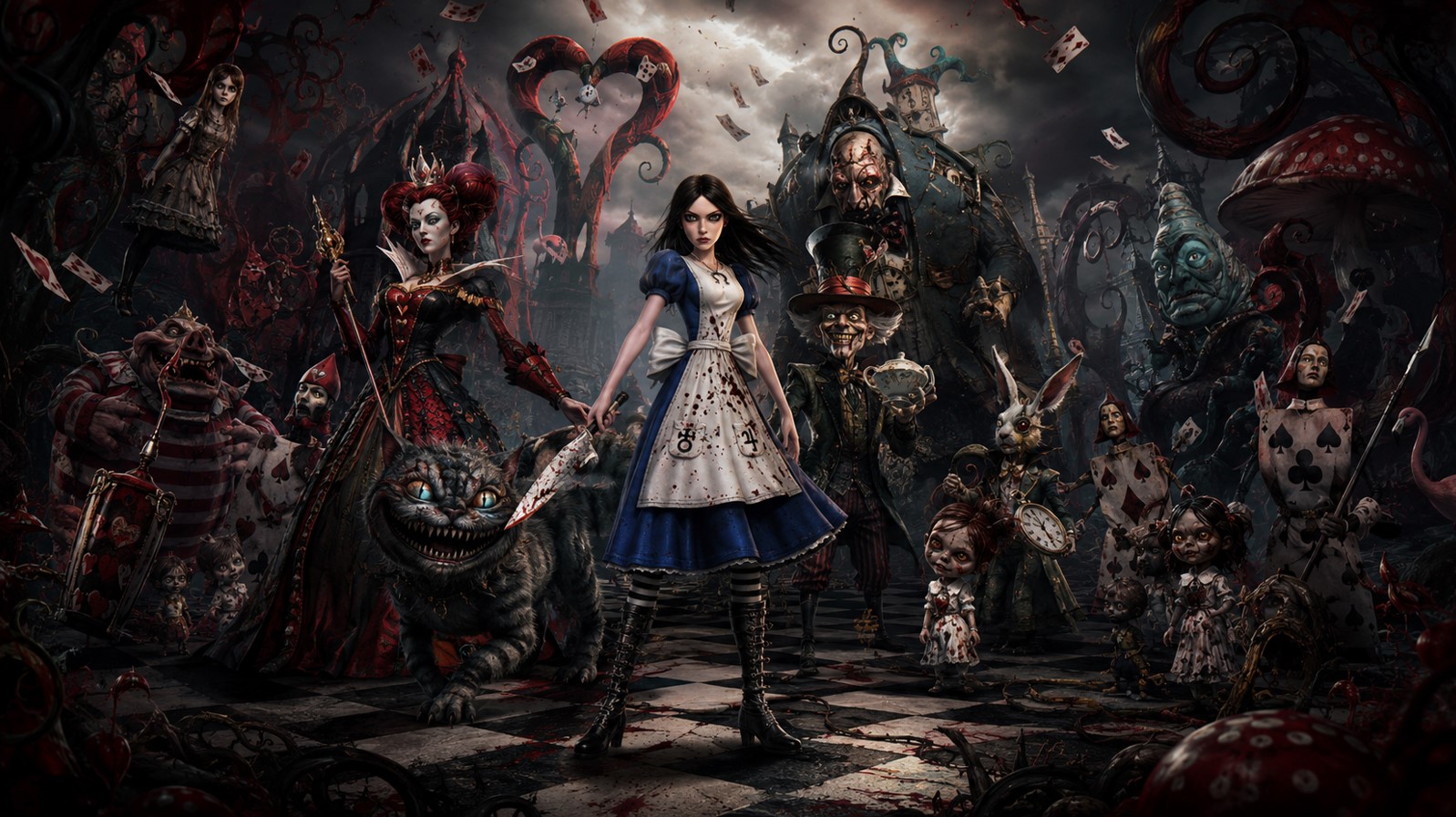
Alice Madness Returns Characters Are All the Same Person
Here’s the trick that makes this game work, and it takes most players until the final act to notice. Nobody in Wonderland is talking to Alice. They’re talking as Alice. Every cat, hatter, and caterpillar is a fragment of one traumatised woman’s mind trying to deliver a message she isn’t ready to hear, and the whole game is structured as an argument she’s having with herself in costume. Once you read the cast of Alice Madness Returns characters that way, characters who seemed like whimsical set dressing turn into something much more deliberate. So let’s go through them properly.
Quick note before we start: this game deals directly with child abuse and its aftermath. I’ll discuss the plot as the game presents it, without detail.
Spicy Horse released this in 2011 as the sequel to American McGee’s Alice, published by EA. The setup: Alice Liddell survived a house fire that killed her family, spent years institutionalised, and now lives at an orphanage under the care of Dr. Angus Bumby, who’s treating her with hypnotherapy aimed at making her forget.
Wonderland is her coping mechanism. It always was. And this time it’s being corrupted from outside, which is the game telling you – in level design rather than dialogue – that something in her real life is doing damage.
The clearest signal is the enemy design. The Ruin are oily blobs assembled from doll limbs and train parts, and they’re deliberately alien to even the strangest corners of Wonderland. They don’t belong to Alice’s imagination. That’s the point. They’re evidence that an outside force has got into her head, and their components – dolls and trains – are the two things that eventually name the culprit.
So the reading rule for the whole cast: the more a character insists on something, the more Alice has been avoiding it.
The Guide Who Refuses to Help!
The Cheshire Cat is the deuteragonist of the series and probably its most beloved design – a skeletal, tattooed shadow of a cat, perpetually grinning, appearing on request to say something unhelpful and vanish.
What’s fascinating is how badly he behaves as a guide. He taunts. He needles. Early on he tells Alice she’s as randomly lethal and entirely confused as she ever was. When she snaps that she’s managed without him so far and he can return to whatever hovel he lives in, his reply is that it isn’t a question of if she’ll need him, it’s when.
He’s not being cruel for the sake of it. Read him as Alice’s own self-awareness – the part of her that already knows the truth and can’t say it directly, so it circles instead, poking, provoking, refusing to let her settle. His job isn’t to give her the answer. It’s to stop her from getting comfortable.
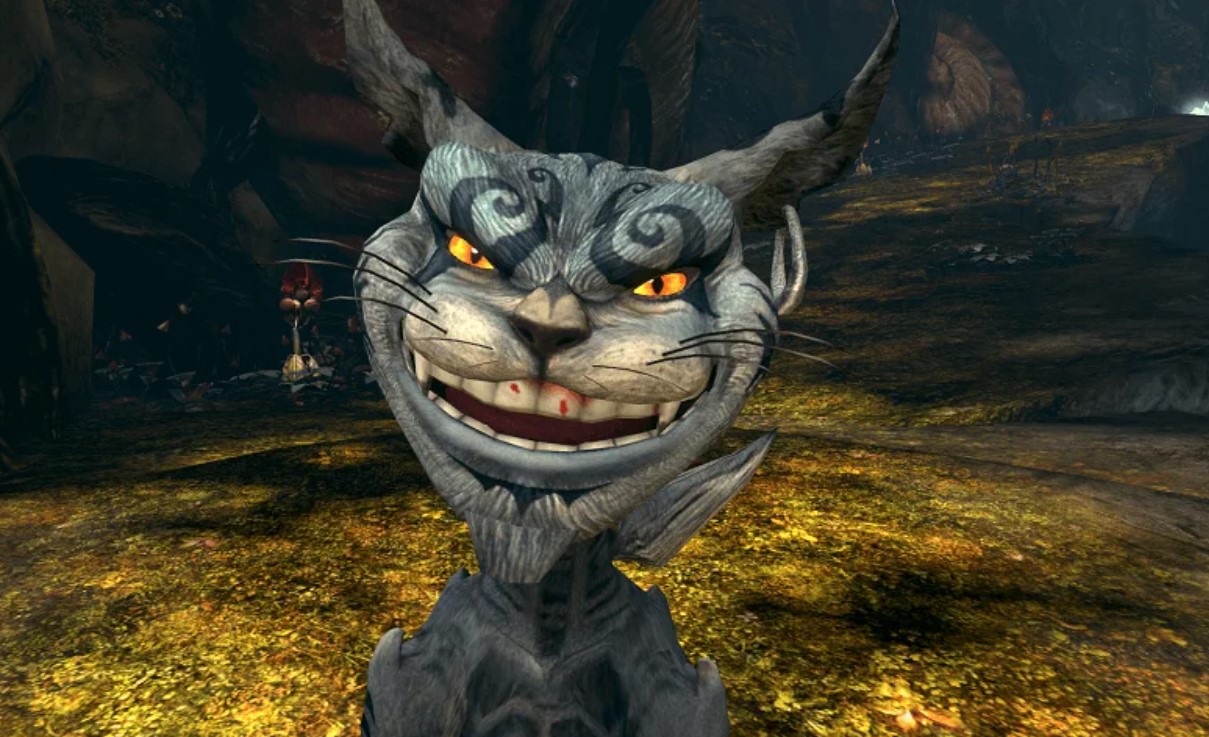
Roger Jackson voices him, along with the Mad Hatter and the March Hare, which is a nice bit of casting economy that also quietly reinforces how much of Wonderland is one voice wearing different masks.
| Character | Function in Alice’s mind |
|---|---|
| Cheshire Cat | Self-awareness that won’t let her rest |
| Mad Hatter | The cost of forcing yourself to forget |
| Caterpillar | Moral judgement about inaction |
| Queen of Hearts | Buried memory, in her own childhood form |
| Dollmaker | Bumby’s presence inside her mind |
| The Ruin | Evidence of outside interference |
| Insane Children | The orphans she failed to notice |
The Witnesses: Three Characters, Three Confessions
The middle of the game is structured as a chain of interrogations. Alice goes to a Wonderland figure, asks for help, and gets a piece of the truth she doesn’t want. Each one is harder than the last.
The Mad Hatter goes first, and his condition is the message. His domain is elaborate clockwork; he himself has been taken apart, with the March Hare and Dormouse – his former tea companions – having turned the tables on their old host. When Alice demands help boarding the train, he spends his last moments trying to hold a tea party instead. She finds the irony completely lost on her.
What he actually communicates, rambling and delusional, is that forcing herself to forget was never the solution – it’s the source of her confusion. Which is a fairly precise description of what Bumby’s therapy is doing to her, delivered by a character who has himself been dismantled and reassembled by outside hands.
The Caterpillar delivers the hardest verdict, and it’s not aimed at Bumby.
He tells Alice that because she was so consumed by her own pain, she became oblivious to what Bumby was doing to the other children at the orphanage – and that perhaps she deserves punishment for not seeing it. The formulation, as fans have parsed it, is that abusers must be punished, but perhaps so should witnesses who choose not to interfere.
That’s an unusually uncomfortable thing for a game to say about its own protagonist. Alice is a victim, unambiguously. She’s also, the game insists, someone who was standing close enough to see other children being harmed and was too far inside her own grief to look. The Caterpillar exists to say that out loud.
The Queen of Hearts delivers the actual revelation. She survived her defeat in the first game in diminished form, and when Alice reaches her castle, the Queen’s true shape is revealed as Alice’s own younger self.
That reveal reframes the entire first game retroactively. The thing Alice executed to save her sanity was a version of herself – specifically, the version who held the memories. And the Queen’s information is the centre of the plot: Lizzie wasn’t talking in her sleep on the night of the fire. Alice had constructed a fantasy image to explain what she heard, and the Queen dismantles it.
Her instruction to Alice afterwards is the game’s thesis in one line: make your survival of the fire mean something, or Wonderland and you are both doomed.
Note what all three have in common. None of them helps. All three accuse. The support cast of this game is a tribunal.
The Villain and His Shadow
Dr. Angus Bumby is the psychiatrist running Houndsditch Orphanage, and one of the more genuinely repellent antagonists in the medium – not because of spectacle, but because his method is so bureaucratic. He uses hypnotherapy to erase children’s traumatic memories, leaving them, as the game frames it, blank and marketable. He set the Liddell fire to destroy the evidence of what he’d done to Lizzie, and he intended the same fate for Alice once her memories were gone.
His Wonderland counterpart is the Dollmaker, and the design is one of the most effective translations of a real-world figure into psychological imagery that games have produced. He’s a giant Bumby with fountains of oil where his eyes should be and puppets for hands. He drives the Infernal Train, which looks like a motorised gothic cathedral converting Wonderland into a steampunk hell.
The Insane Children live in his Dollhouse, and they’re the game’s saddest addition. In the original they had no purpose and no dialogue. Here they’re fully voiced residents being turned into mindless dolls – a direct visual translation of what Bumby is doing to real orphans in London. One of them, encountered as half a child in a foggy Hyde Park, begs Alice not to abandon them again. That’s the moment her focus starts shifting outward.
The relationship between the two villains is the neatest structural idea in the game. Alice can’t confront Bumby directly – her mind won’t let her – so she builds a version she can fight. Destroy the Dollmaker in Wonderland and she gains the clarity to face the man in London.
The London Cast Nobody Talks About
Wonderland gets the attention. But the real-world characters are doing precise work, and they’re often nastier than anything with tentacles.
Pris Witless is Alice’s old nurse, and the game has a very sharp piece of irony attached to her. She believes that if she hadn’t placed Alice in Bumby’s care, the girl would have ended up on the streets selling herself. She has no idea that’s precisely what Bumby has planned once he’s finished erasing Alice’s memories. She thinks she’s saved her. She delivered her.
Nan Sharpe and the rest of the London figures fill out a city that’s genuinely grim – Alice gets pulled from a dirty river by dock workers, rescued from a burning brothel, and thrown in jail across the game’s real-world segments.
Lizzie Liddell is the character who never appears alive and shapes everything. Alice’s older sister, who confided in her about Bumby’s advances, who had a mischievous streak, who knew how to sneak out while grounded. The family lawyer tells Alice that Lizzie died first in the fire despite being furthest from its source, and that her door was locked – which is the detail that should have told everyone something was wrong and didn’t.
Worth noting for anyone digging into the lore: cut content from the game made Alice’s understanding of Lizzie’s fate considerably more explicit than the shipped version does. What made it into the final game is deliberately less direct, which some players read as restraint and others as studio caution.
A few things about the cast worth keeping in mind:
- The in-game almanac is a character study, not a bestiary. The Extra Content characters section is annotated with Alice’s own commentary and opinions, so you’re reading her impressions rather than neutral descriptions.
- Nearly every ally accuses her of something. Cheshire, Hatter, Caterpillar, and the Queen all take turns holding her responsible for what happened to Wonderland or to the orphans.
- Physical corruption tracks psychological damage. The Hatter dismantled, the Queen reduced, Wonderland industrialised – the state of each character reports the state of Alice’s mind at that point.
| London | Wonderland |
|---|---|
| Dr. Bumby | The Dollmaker |
| Orphans at Houndsditch | The Insane Children |
| Bumby’s therapy erasing memories | The Infernal Train corrupting Wonderland |
| Lizzie’s death, suppressed | The Queen of Hearts, diminished but alive |
| Alice’s returning lucidity | Wonderland’s restoration |
The Ending, and Why the Cast Earns It
Alice destroys the Dollmaker, then confronts Bumby at Moorgate Station and threatens to go to the police. He admits everything – including setting the fire after Lizzie refused him, to remove any witnesses.
And then Alice realises he’ll escape punishment. So she pushes him in front of a train, in what the game presents as tranquil fury rather than a scream.
It’s a brutal ending and it only works because of the cast that built to it. Every one of those accusatory conversations was preparing this. The Caterpillar said witnesses who don’t interfere should be punished too. The Queen told her to make her survival mean something. Alice does both at once, by refusing to be a witness one more time.
The final beat belongs, appropriately, to the Cheshire Cat. Emerging from the station, Alice finds London and Wonderland have merged, and the Cat monologues over the changed streets, ending on the note that both Alice and Wonderland are safe – for now.
Fourteen years later that “for now” is still doing a lot of work in the fandom.
FAQ
Who is the main villain?
Dr. Angus Bumby, the psychiatrist at Houndsditch Orphanage, who erases children’s memories to make them exploitable. His Wonderland form is the Dollmaker, who drives the Infernal Train.
Is the Cheshire Cat good or evil?
He’s the deuteragonist and functions as Alice’s guide, though a deliberately abrasive one. Read him as her own self-awareness, refusing to let her stay comfortable in denial.
Who is the Queen of Hearts really?
Her true form is revealed to be Alice’s younger self. She survives from the first game in reduced capacity and delivers the crucial information about the night of the fire.
What happened to Lizzie Liddell?
Alice’s older sister died first in the fire despite being furthest from its source, with her door locked. Bumby later admits he set the fire after she refused him, to eliminate witnesses.
Who are the Insane Children?
Residents of the Dollmaker’s Dollhouse, being turned into dolls. They had no dialogue in the first game and are fully voiced here, mirroring Bumby’s real orphans.
What are the Ruin?
Enemies made from doll limbs and train parts, deliberately alien to Wonderland’s usual logic. They signal that the corruption comes from outside Alice’s imagination.
Does Alice kill Bumby?
Yes. After he confesses and she realises he’ll evade justice, she pushes him into the path of a train at Moorgate Station.
Final Thoughts
What makes the Alice Madness Returns characters remarkable isn’t their designs, striking as those are. It’s that the game refuses to give its protagonist a single ally who simply supports her. The cat mocks her, the hatter rambles at her, the caterpillar convicts her, and the queen turns out to be the child she thought she’d killed. Every conversation is Alice arguing with a piece of herself she’d rather not meet, and the game only lets her win once she’s met all of them. That’s a bolder structure than most games attempt now, let alone in 2011 – and it’s why people are still writing symbolism essays about a mid-budget action game a decade and a half later.
P.S. If this reframed a game you thought you’d already finished thinking about, passing it along is the easiest way to keep our small team writing pieces with this much reading behind them. Bookmark it too, since the London-to-Wonderland mirror table is the sort of thing that’s far more useful on a replay than a first playthrough. And if creative or commercial collaboration is what brought you here, the T-Minus team is glad to hear from you directly.