
Top Sega Dreamcast Games You Still Should Play
Some consoles just leave a mark. The Sega Dreamcast is one of them. It lived a short life – barely two and a half years on store shelves – yet people still talk about it like it dropped last week. And honestly? They’ve got a point. Sega’s last machine showed up early, swung big, and lost the war to the PlayStation 2. But the library it left behind has aged like a good bottle of something. We’re talking arcade ports that somehow beat the arcade, online play before broadband was a household word, and oddball little experiments no big publisher would greenlight today. Let’s check the best Dreamcast games you still should play nowadays.
So grab a controller. Here’s a tour of the games, the genres Sega quietly nailed, and the wild fan scene that won’t let this console rest in peace.
Why Dreamcast Games Still Feel Ahead of Their Time?
Let me set the scene. The Dreamcast launched in Japan on November 27, 1998, then landed in North America on September 9, 1999. That “9/9/99 for $199” pitch is still one of the slickest marketing lines the industry’s ever cooked up. Europe got it that October. And for a hot minute, Sega looked like it was back on top – the US launch moved over a million units fast, and by Christmas of ’99 Sega held nearly a third of the North American market.
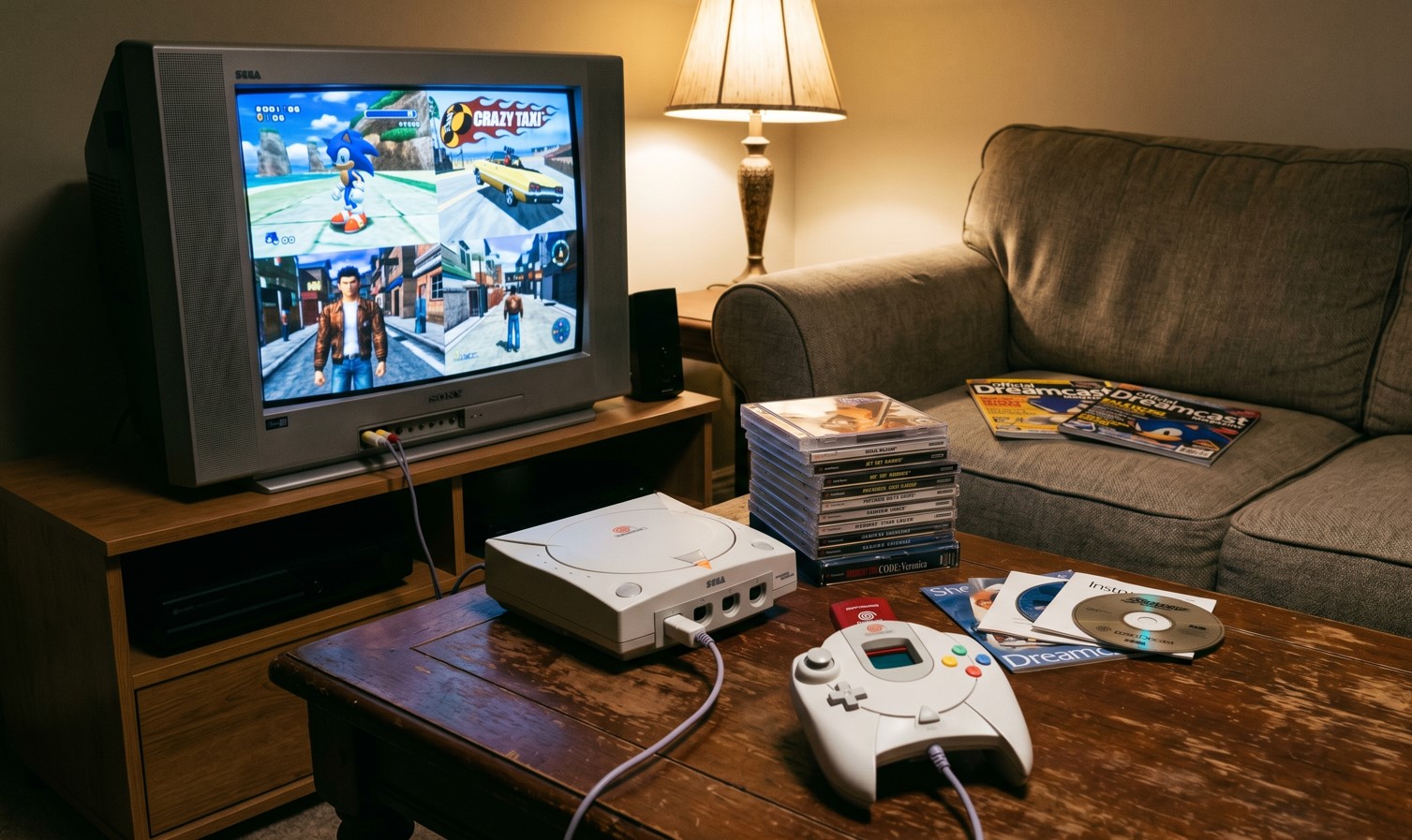
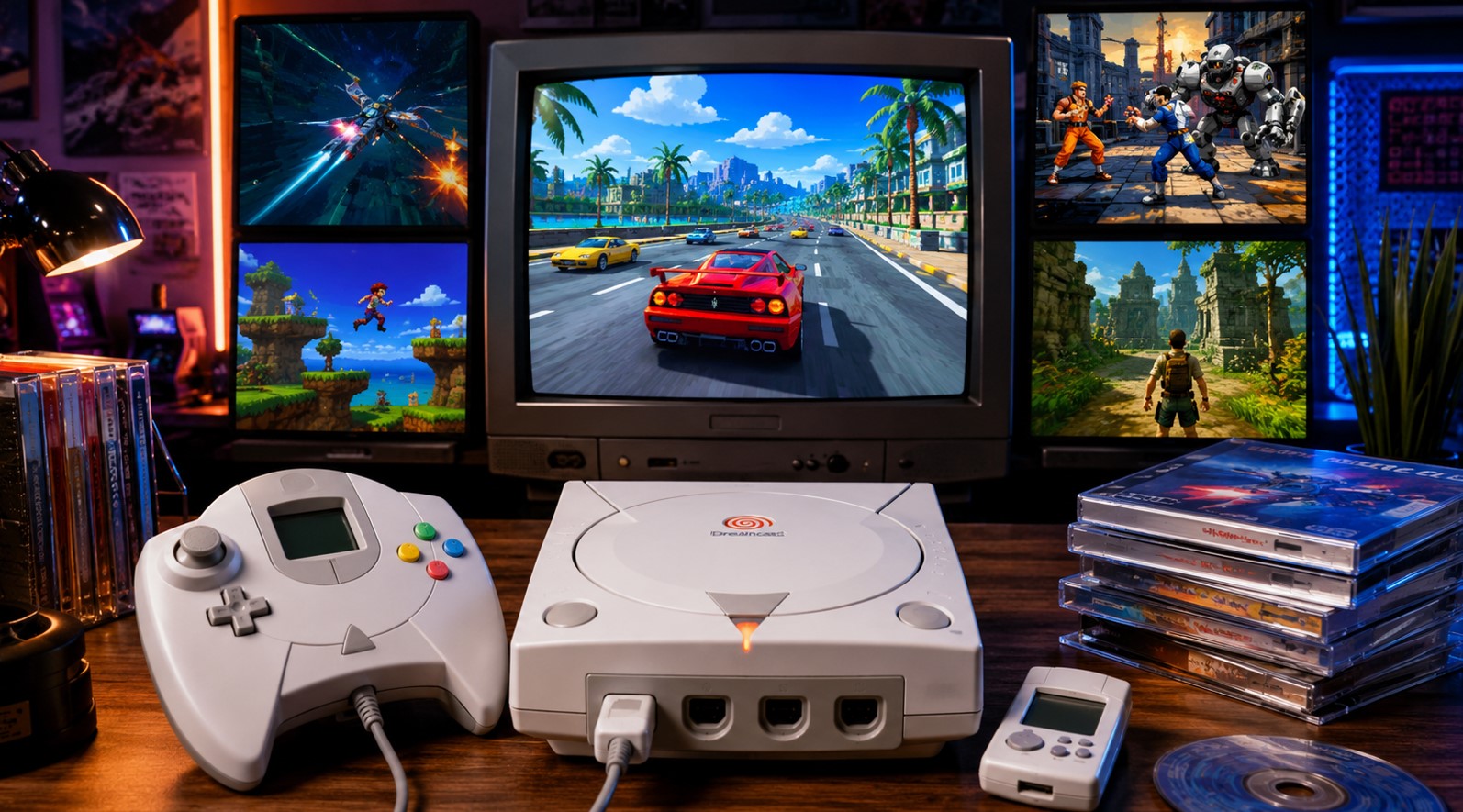
Here’s the thing about the hardware, though. It punched way above its price tag. Inside sat a Hitachi SH-4 chip and an NEC PowerVR2 graphics processor, with games stored on GD-ROM discs that held about a gigabyte each. Sega shared the guts with its NAOMI arcade board, which is why so many coin-op conversions came home looking nearly pixel-perfect. You weren’t playing a watered-down version. You were playing the real thing on your couch.
But the headline trick? A modem, built right in. The Dreamcast was the first console to ship with one out of the box, beating the PS2 to online play by a full year. Sega even ran a service called SegaNet so you could hop online and trade blows with strangers. That was unheard of in 1999. Most folks were still wrestling with dial-up just to check email.
Then there’s the VMU – that goofy little memory card with its own tiny LCD screen and buttons. It doubled as a pocket-sized handheld. You’d raise a Chao in Sonic Adventure, call football plays in NFL 2K without your buddy peeking, or pop it out and play a mini-game on the bus. Nobody had seen anything quite like it. Decades later, fans are still finding new tricks for it – more on that circus later.
So when people say the Dreamcast was ahead of its time, this is what they mean. Online multiplayer, a second-screen gadget, downloadable extras – Sega was sketching the future on a napkin while everyone else was still arguing about polygons.
The Dreamcast Games That Defined the Console
Every console has its holy trinity. The Dreamcast has more like a holy starting lineup.
These are the heavy hitters – the ones that show up on every “greatest of all time” list and still get name-dropped at retro meetups.
- Sonic Adventure kicked things off as a launch title and went on to become the system’s best-selling game, moving roughly 2.5 million copies worldwide. It was Sonic’s first proper leap into 3D, and yeah, it’s janky in spots now. Still, that opening dash down the streets of Station Square hit like nothing else at the time.
- Soulcalibur might be the single best argument for the console. Namco’s weapon-based fighter showed up at launch and basically embarrassed the arcade original. Critics lost their minds. It’s the kind of port that made people believe Sega’s “arcade at home” promise wasn’t just talk.
- Shenmue was Yu Suzuki’s wildly ambitious open-world drama – forklift driving, capsule toy machines, a revenge plot that still hasn’t fully wrapped up. It cost a fortune to make and helped invent the open-world template we take for granted now.
- Crazy Taxi brought the arcade’s reckless, Offspring-blasting cab chaos home, and the Dreamcast port still holds the crown as the best one.
- Jet Set Radio dropped a year later with cel-shaded graffiti gangs and a soundtrack that slaps to this day.
- And Phantasy Star Online turned strangers into dungeon-crawling teammates over that built-in modem – the first real online RPG on a console.
| Game | Year | Genre | Why It Mattered |
|---|---|---|---|
| Sonic Adventure | 1998/99 | 3D Platformer | Launch title, best-selling Dreamcast game ever |
| Soulcalibur | 1999 | Fighting | Arcade port that outclassed the arcade |
| Shenmue | 1999/2000 | Open-World Adventure | Pioneered the open-world rabbit hole |
| Crazy Taxi | 1999/2000 | Arcade Racing | The definitive version, full stop |
| Jet Set Radio | 2000 | Action | Cel-shading and a legendary soundtrack |
| Phantasy Star Online | 2000/01 | Online RPG | First true console online RPG |
Notice something? Half of these basically invented genres or styles we still play. Not bad for a console that flopped.
Fighting Games Were the Dreamcast’s Secret Weapon
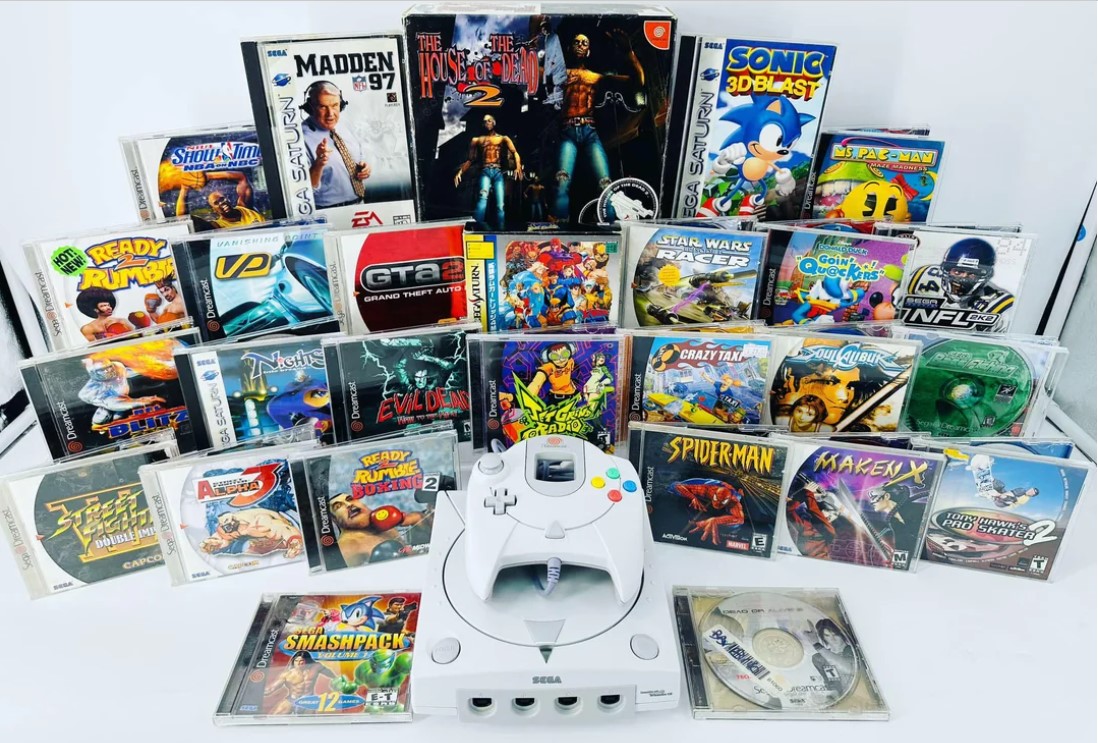
If you ask the fighting game crowd why they kept their Dreamcast hooked up long after Sega bailed, you’ll get the same answer over and over. The thing was a fighting game machine. That NAOMI arcade connection meant the ports were spot-on, and the genre was having a golden moment.
Want the short list of why the fighting community still loves this box? Here you go:
- Marvel vs. Capcom 2 crammed 56 characters onto one roster and let chaos reign. It became the tournament staple for years and only really left the scene when newer hardware caught up.
- Capcom vs. SNK 2 delivered the dream crossover with a groove system deep enough to write essays about.
- Street Fighter III: 3rd Strike brought parries and that famous Daigo moment energy into living rooms.
- Power Stone 1 and 2 turned fighting into a free-roaming, item-grabbing brawl that felt closer to a party game with knives.
- Dead or Alive 2 showed off counters, multi-tiered stages, and graphics that made jaws drop in 2000.
The funny part? A lot of these never got better home versions for ages. Players hung onto their Dreamcasts specifically for this stuff. When your “outdated” console runs the best version of a tournament game, you don’t exactly rush to replace it.
Genres the Dreamcast Quietly Perfected
Beyond the marquee names, the Dreamcast was a playground. Sega restructured its studios into nine semi-independent teams around 2000, and that freedom shows. You can feel the swing-for-the-fences energy in the catalog. Some bets missed. Plenty landed. And a handful created things gaming had never seen.
Take sports. Here’s a fact that surprises people: the whole 2K dynasty was born here. Visual Concepts’ NFL 2K and NBA 2K launched on the Dreamcast, and they were so sharp that NFL 2K1 still sits at a 97 on Metacritic. Sega Sports basically rewrote what a console sim could look like, and that franchise is, what, still going strong a quarter-century later? Wild legacy for a so-called failure.
Horror got its moment too. Resident Evil – Code: Veronica was the first proper Resident Evil built for a 128-bit machine, ditching the pre-rendered backgrounds for fully 3D environments. It moved over a million copies and gave the series a real glow-up. Pair it with the light-gun mayhem of House of the Dead 2, and the Dreamcast had the scares covered long before anyone called this stuff “survival horror comfort food.”
When Sega Got Weird (and It Worked)?
Look, the Dreamcast had a strange streak, and that’s a compliment. Seaman was a virtual pet sim where you raised a fish with a human face and talked to it through a microphone. It judged you. It got bored of you. It was deeply unsettling and weirdly compelling.
Space Channel 5 starred a reporter named Ulala dancing to fend off an alien invasion – a rhythm game wrapped in retro-future style. Samba de Amigo shipped with maraca controllers, because of course it did, and Nintendo’s Shigeru Miyamoto reportedly fell for it. Typing of the Dead took the zombie light-gun shooter House of the Dead 2 and swapped guns for a keyboard, so you killed the undead by typing words fast. Genius nonsense.
And then Rez, Tetsuya Mizuguchi’s rail-shooter built around music and synesthesia, where every shot pulses with the beat. It’s less a game than a vibe you steer through. People still chase that high.
That’s the magic. Where else would a fish-man simulator and a maraca rhythm game share a shelf with a tournament-grade fighter? The Dreamcast didn’t play it safe, and the library is richer for it.
Hidden Gem Dreamcast Games You Probably Missed
Now we get to my favorite part. For every Sonic Adventure that everybody owned, there’s a quiet classic that slipped through the cracks. The console died young, marketing budgets dried up, and a bunch of brilliant Dreamcast games never found the audience they deserved.
Here’s a starter pack worth hunting down:
- Skies of Arcadia – a sky-pirate RPG with airship battles and one of the most charming casts in the genre. Sadly it never got a proper modern re-release, which keeps prices spicy.
- Grandia II – a turn-based RPG with a combat system people still rank among the best ever made.
- Ikaruga – a bullet-hell shooter built around a polarity-switching gimmick that’s pure puzzle-box brilliance.
- Headhunter – the closest thing the console got to Metal Gear, complete with stealth and a moody atmosphere.
- Bangai-O – a frantic mech shooter from Treasure that’s all about screen-filling explosions.
- Illbleed – a survival-horror oddball so cult it’s basically a dare.
Honestly, you could build a whole second console’s worth of greatness out of just the overlooked Dreamcast games. That’s how stacked the library got in such a short window. The tragedy is also kind of the appeal – collecting these feels like rescuing something the world forgot.
The Online Console Before Online Was Cool
I keep circling back to the modem because it genuinely mattered. Most of us in 1999 thought “online gaming” meant Quake on a clunky PC. The Dreamcast said, nah, watch this.
Phantasy Star Online was the killer app. You’d party up with three other players – sometimes from across the planet – and grind through dungeons together, chatting through a clever word-select system that dodged language barriers. For a lot of players, it was their first taste of cooperative online play, period. That feeling stuck.
Other titles leaned in too. ChuChu Rocket, that frantic puzzle game from Sonic Team, let four players sabotage each other over the wire. Quake III Arena got a proper port. Even NFL 2K had online modes for a brief, glorious window.
So what’s the online situation today? Surprisingly alive, thanks to die-hard fans:
- Community-run private servers have brought Phantasy Star Online back from the dead, so you can still party up in 2026.
- A Japan-only real-time strategy game called Hundred Swords was nudged back online by enthusiasts this year.
- Propeller Arena – a Yu Suzuki-produced shooter shelved after 9/11 because of its imagery – finally re-entered testing nearly 25 years later, online and all.
Think about that. The official servers went dark ages ago, and yet a stubborn crowd keeps relighting them one by one. That’s not nostalgia. That’s devotion.
How to Play These Classics Today?
Alright, you’re sold. You want in. Good news: getting into Dreamcast games has never been easier, and you’ve got a few routes depending on how much of a purist you are.
The original-hardware path is the romantic one. A working Dreamcast plus a modern optical drive emulator – the GDEMU or MODE, basically a gadget that loads games off an SD card instead of a disc – gives you the authentic feel without hunting down pricey, scratched-up GD-ROMs. Early units could even boot burned discs thanks to a quirk in the system’s MIL-CD support, which is how the homebrew scene got rolling in the first place.
Prefer convenience? Emulators have come a long way. Flycast is the go-to these days and runs great inside RetroArch, while Redream is the friendly option that upscales these games to crisp HD with almost zero fuss. Suddenly Soulcalibur looks sharper than it ever did on a CRT.
And then there are the official re-releases. Sega’s been generous over the years, porting a chunk of the catalog to modern storefronts. Here’s the lay of the land:
| Way to Play | What You Get | Best For |
|---|---|---|
| Original hardware + ODE | True-to-1999 feel, every game | Purists and collectors |
| Flycast / Redream | HD upscaling, save states, cheap | Newcomers and tinkerers |
| Official re-releases | Curated classics, legal, easy | Casual players on a budget |
A heads-up on that last row, though – and here’s the catch. The official ports cover the hits like Jet Set Radio, Crazy Taxi, Sonic Adventure, and the Shenmue HD collection, but plenty of gems (looking at you, Skies of Arcadia) never made the jump. For the deep cuts, you’re back to hardware or emulation. A little contradictory, sure, but that’s retro life: the easy path covers the famous stuff, and the rare stuff makes you work for it.
The Homebrew Scene That Refuses to Die
Here’s where it gets genuinely wild. You’d figure a console that got discontinued back in March 2001 would be a closed book by now. Nope. The Dreamcast homebrew scene isn’t just alive – it’s arguably having its best stretch ever.
Insiders started calling 2025 “the year of the Dreamcast port,” and they weren’t kidding. One developer, known online as jnmartin84, has been on an absolute tear, bringing polished conversions of Doom 64 and Wipeout to the system. Then late last year he got Star Fox 64 running on real hardware. A Mario Kart 64 port has been grinding through its final bug-testing toward an alpha release. Somebody else ported Sonic Mania. There are working builds of GTA III and Vice City floating around. The roguelike darling Balatro is reportedly heading there too.
How is this even possible? Tools. A development kit called DreamSDK got a massive overhaul in 2025 – its first big update in two years – bundling a modern toolchain so coders don’t have to fight ancient software just to make something boot. That lowered the barrier, and the floodgates opened.
The hardware side is buzzing as well. New wireless controllers like the DreamConn S have shown up, 8BitMods has been pushing accessories like the BitLink and a souped-up “VMU Pro,” and one homebrew shmup figured out how to drive two VMU screens at once. Somebody actually did it. A 25-year-old “dead” console is getting fresh games and fresh gadgets in 2026 – try explaining that to your 1999 self.
That’s the real legacy, if you ask me. The Dreamcast lost the commercial fight in spectacular fashion. But the love never faded, and a global crew of fans keeps building on it, port by port, mod by mod. Most consoles get a museum exhibit. This one got a fan club that never clocked out.
FAQ
Are Dreamcast Games Still Worth Playing in 2026?
Absolutely. Loads hold up thanks to that arcade-quality polish, and emulators like Redream make them look sharp on a modern TV. The fighters, racers, and oddball experiments especially still feel fresh.
What’s the Best-Selling Dreamcast Game?
Sonic Adventure, hands down. It moved around 2.5 million copies worldwide as a launch title and remains the system’s top seller.
Can You Still Play Dreamcast Games Online?
Yes, in spots. Official servers are long gone, but fan-run private servers have revived Phantasy Star Online and a few other titles, so co-op is still on the table.
How Many Games Did the Dreamcast Have?
The library tops 600 games across all regions, from blockbuster launch titles to quirky Japan-only releases. New homebrew keeps padding that number even now.
Is the Dreamcast Hard to Emulate?
Not really. Flycast and Redream both run the catalog well on modern machines, with upscaling and save states. It’s one of the smoother retro consoles to get going.
Why Did the Dreamcast Fail?
A few reasons stacked up: the PlayStation 2’s hype and DVD player stole the spotlight, third-party support stayed thin, and Sega’s earlier flops with the 32X and Saturn had already burned a lot of trust.
Are New Dreamcast Games Still Being Made?
Yep, more than you’d think. The homebrew community has been cranking out ambitious ports and original titles, with 2025 dubbed “the year of the port” for good reason.
The Console That Lost the War but Won Our Hearts
So here we are. The Dreamcast got roughly 9 million sales, two and a half years on shelves, and a discontinuation notice before most people even understood what it was offering. By the cold numbers, it’s a footnote – the machine that ended Sega’s hardware run.
But numbers miss the point. This little white box gave us arcade-perfect fighters, online play a year ahead of the pack, a memory card that doubled as a toy, and a catalog brave enough to ship a talking-fish simulator next to a tournament classic. It swung for ideas everyone else was scared to touch.
And the best proof of its staying power isn’t in a history book. It’s in the fact that, right now, in 2026, somebody is squashing the last bugs in a Mario Kart 64 port for it. The Dreamcast games we loved never really stopped – the community just picked up the controller and kept the dream going. Pop one in. You’ll get it.
P.S. Ignite our momentum by sharing this post across your social media networks and adding this content to your bookmarks for future inspiration. Your digital support acts as a catalyst, expanding our reach and fueling our team’s passion for what we do. Should you wish to pursue any creative or commercial collaboration, please write to the T-Minus team directly to bring your vision to life.