
Neon White Color Guide: Nobody Reads the Card, They Read the Colour
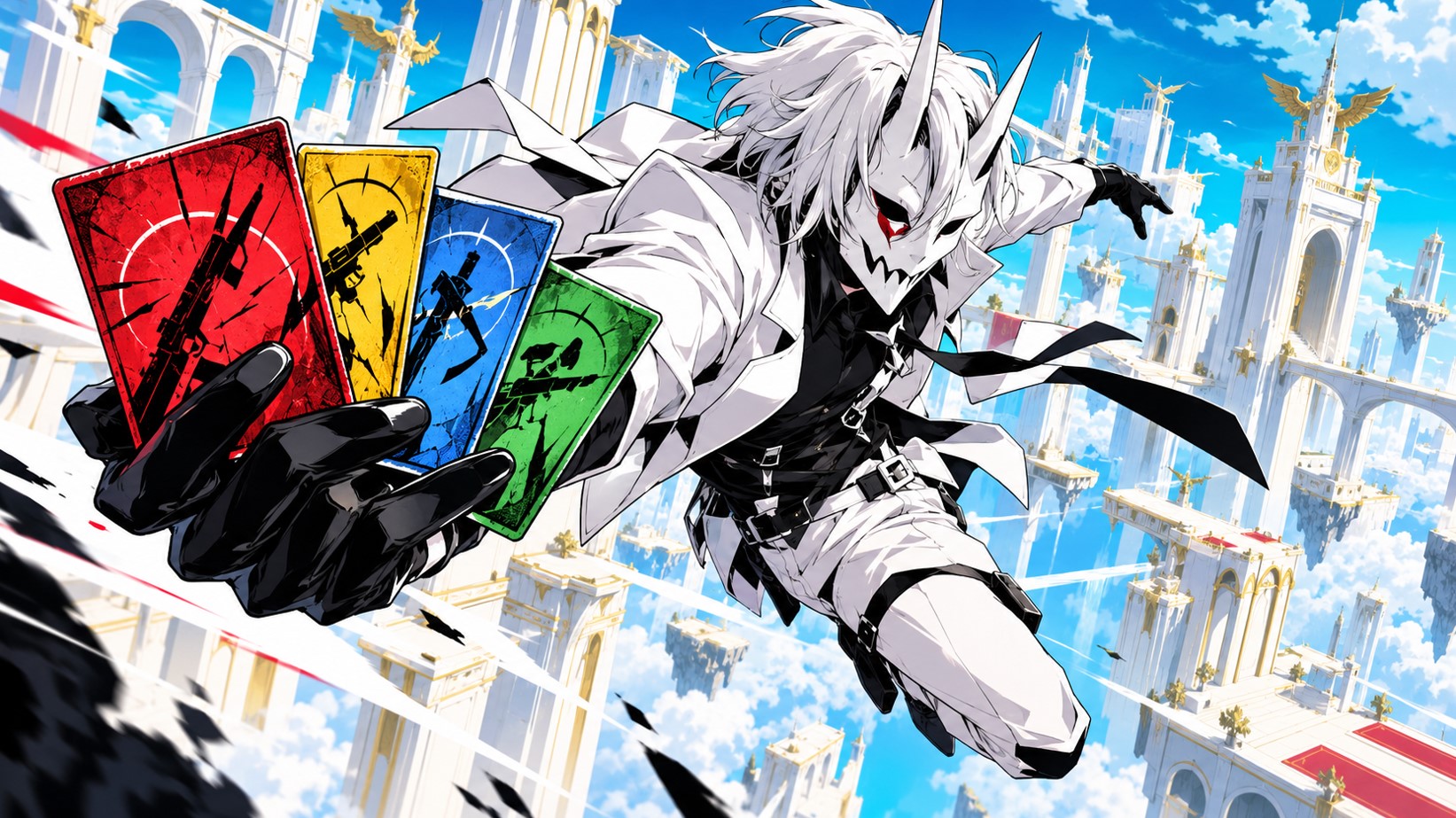
At Ace pace you have about a tenth of a second to identify a card lying on the floor ahead of you, and the word printed on it is not what you are reading. You are reading colour. Yellow means an extra jump is available. Blue means you are about to dash through something. Red means the level wants to throw you somewhere. The names – Elevate, Godspeed, Fireball – are what you say out loud when discussing a route afterwards. Mid-run, they are paint. That is the quiet genius of how Angel Matrix built this Neon White color deck, and it is also why so many runs fall apart on a single misread. Two of the six colours sit close enough together that a tired player grabs the wrong one, and the abilities behind them are nothing alike.
So this is a palette reference rather than a tier list. Every colour in the game, what sits behind it, and the mistake that colour specifically causes.
| Colour | Card | Weapon | Discard Ability |
|---|---|---|---|
| Yellow | Elevate | Semi-automatic pistol | Extra jump, vertical boost |
| Purple | Purify | Assault rifle | Sticky explosive that can launch you |
| Green | Stomp | Submachine gun | Downward stomp with a damaging shockwave |
| Blue | Godspeed | Semi-automatic rifle | Horizontal dash that destroys demons in its path |
| Red | Fireball | Shotgun | Explosive launch in the direction you face |
| Light blue | Dominion | Rocket launcher | Grappling hook to surfaces in range |
| Grey | Katana | Melee sword | None – roughly 30 swings |
| Grey | Fist | Fists | None – ten punches, and the tenth kills you |
| Cream | Book of Life | Final-mission weapon | Teleport-kill along a line of sight |
| Magenta | Health | Pickup | One heart restored |
| Off-white | Ammo | Pickup | Refills one magazine of the active card |
Eleven colours, six of which are actual tools. Let’s take them in the order you will meet them.
Yellow Is Height
Elevate is the pistol, and it is the first card most players learn to trust completely.
Primary fire is a single medium-damage shot per pull, which makes it the clean answer to one demon standing on its own. The discard gives you an extra jump – a vertical boost that functions as a double jump when you are already airborne.
Yellow is therefore the colour of reaching something. When a level litters yellow cards along a route, it is telling you the ceiling is the path. Three Elevates in a row usually means three ascending platforms with no other way up.
The habit to build: spend Elevate at the apex of your existing jump, not from the ground. You get far more height stacking the boost onto upward momentum than from a standing start, and almost every Gold-to-Ace gap on early levels comes down to that one timing.
Purple Is a Sticky Bomb
Purify is the assault rifle, and purple is the most misunderstood colour in the game.
Its primary fire is an automatic burst in a mostly straight line, which makes it the crowd-clearing option for a cluster of demons. But the discard is where the value sits: a sticky explosive that attaches to surfaces and enemies, detonates, and can launch you.
That dual purpose is the thing. Purple is both a weapon and a movement tool, and new players tend to see only the first half. Plenty of Ace routes depend on sticking a Purify charge to a wall, stepping back, and riding the blast.
Which gives purple a particular signature in level design:
- Purple near a group of demons usually means the rifle itself is the intended answer.
- Purple near a blank wall or floor with nothing to shoot means the explosive is the point, and the route goes up or across.
- Purple immediately before a locked gate often means the charge opens it rather than a shot doing so.
- Two purples in a level rarely means two firefights – the second is almost always movement.
Green Is Downward
Stomp is the submachine gun, and the colour tells you to look down rather than up.
Primary fire is a fast, weak automatic spray with a wide spread – the worst single-target option in the deck and the best panic button when three demons are at point-blank. The discard sends you slamming downward with a shockwave that damages whatever is beneath you.
Green is consequently the colour of two situations: a mess of enemies at close range, or a cluster of them directly below a ledge you are standing on. If you see green on a high platform, check what is underneath it before you do anything else.
Neon White Color Guide to the Two Blues
Here is the pair that costs more runs than anything else in the game, and it deserves its own section.
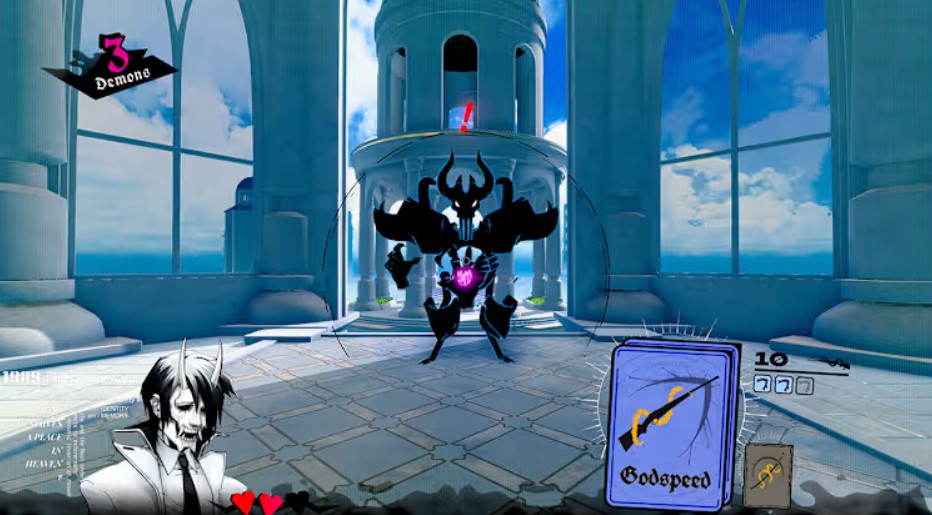
Blue is Godspeed. Semi-automatic rifle, powerful and precise at long range, and the discard is a horizontal dash that destroys demons caught in its path. It moves you forward and kills on the way.
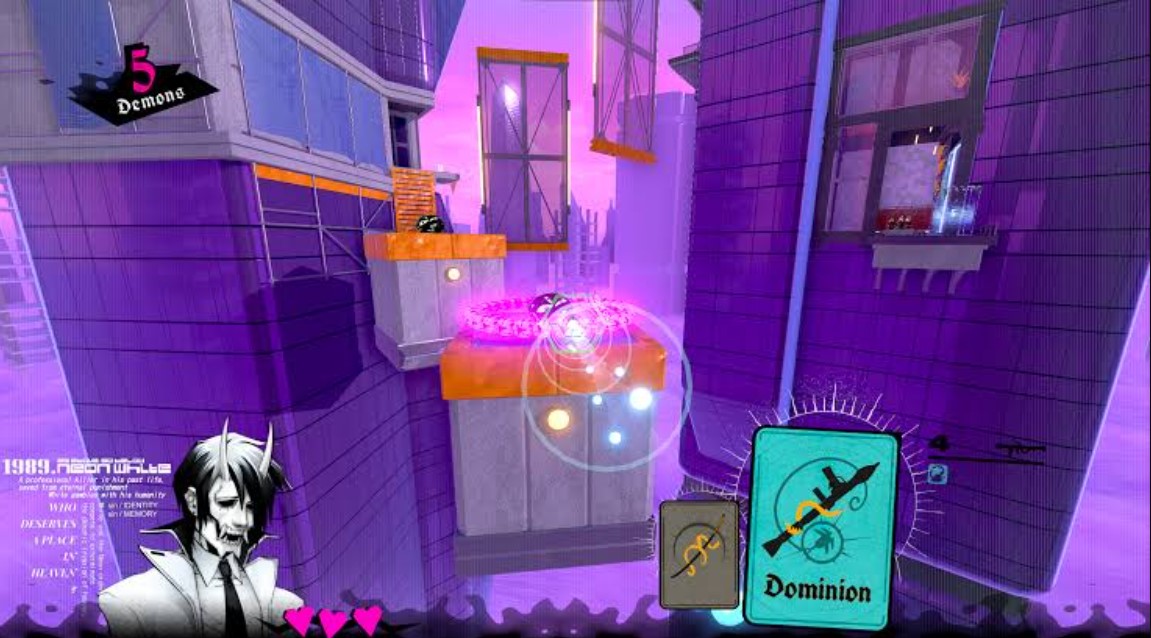
Light blue is Dominion. Rocket launcher, explosive on impact, capable of launching you with its own blast, and the discard is a grappling hook that pulls you toward a surface in range.
Both move you horizontally. Both are blue. And they are not remotely interchangeable.
| Blue – Godspeed | Light blue – Dominion | |
|---|---|---|
| Weapon | Semi-automatic rifle | Rocket launcher |
| Primary fire | Single precise long-range shot | Explosive that detonates on impact |
| Discard | Dash forward, killing demons in the path | Grappling hook toward a surface |
| What it needs | A line to run through | A surface within range to pull to |
| What happens if you confuse them | You grapple into empty air, or dash past the grapple point you needed | Same mistake, opposite direction |
The practical tell is range and brightness rather than hue. Godspeed’s card reads as a deeper, flatter blue; Dominion’s reads lighter and colder. In bright level lighting that difference compresses, which is exactly when people grab wrong.
Three things that help:
- Learn the pair by position, not by colour. On a route you have run before, you know which pedestal holds which. Colour is for the first attempt.
- Check what is in front of you before you pick up. A long clear corridor wants Godspeed. A gap with a wall or ledge on the far side wants Dominion.
- Remember that Dominion’s primary fire also launches you, so a misgrab is sometimes salvageable by firing a rocket at your own feet instead of grappling.
Red Is Launch
Fireball is the shotgun, and red is the most physical colour in the deck.
Its primary fire is a wide spread of twelve pellets – devastating at contact range, useless at distance. The discard produces an explosive launch in whatever direction you are facing, which makes it the deck’s most flexible movement option because you aim it yourself.
That is the key distinction from everything else here. Elevate sends you up. Stomp sends you down. Godspeed sends you forward. Fireball sends you wherever your crosshair is pointing, including diagonally, including backwards.
So red in a level almost always means the route involves a direction the architecture does not obviously support. If you are staring at a gap that looks unjumpable and there is a red card nearby, the gap is not unjumpable.
The Colours That Are Not Cards!
Four more entries, and overlooking them is a beginner pattern.
Grey, twice. The Katana is White’s default melee weapon with roughly thirty swings, and it can ricochet projectiles back at enemies for a small speed boost – a genuinely useful tool that most players ignore entirely. The Fist card is the other grey, with ten punches, and the tenth one kills you. That is not a penalty mechanic, it is a design joke with teeth, and it means grey is the only colour in the game you have to count.
Cream is the Book of Life, which appears in the final mission on the True Ending path. It fires along a line of sight, destroys its target, teleports you to where that target stood and preserves your momentum with a small lift. It is the most powerful thing in the game and you get it once.
Magenta is health, one heart per pickup.
Off-white is ammo, refilling one magazine of whatever card is active – which matters more than it sounds, because ammo counts are per-level defaults and some stages hand you less than you expect.
Reading a Neon White Color Guide While Actually Running
Colour recognition is a trainable skill, and the game is built to teach it if you let it.
The most underused tool: demons are usually colour-coded to indicate which card they carry before you reach them. That means you can plan two or three cards ahead by looking at what is standing in your way, rather than discovering your options as you collide with them. Players chasing Ace times read the enemy layout as a card sequence, not as a list of targets.
A few habits that transfer directly into better times:
- Scout the level once at walking pace. One slow lap teaching you where each colour sits is worth ten frustrated fast attempts.
- Say the colours out loud on your scouting run. Yellow, purple, blue, red. It sounds ridiculous and it works, because the sequence sticks as rhythm rather than as a map.
- Never pick up a card you have not planned to spend. Holding a card you do not need clutters the slot you want.
- Treat grey as a resource with a counter, since the Fist is the only card in the game that punishes running it dry.
- Watch the medal tiers rather than the clock. Bronze, Silver, Gold and Ace give you four distinct targets, and a hidden red medal sits behind the game director’s own time.
That last one is the honest framing for why any of this matters. Bronze is a participation ribbon. Ace demands that you stop looking at cards and start recognising them, and the red medal demands that you stop recognising them and simply know where they are.
What a Colour Tells You About the Route
The deeper reading, and the thing that separates a Gold player from an Ace one.
Card placement in Neon White is level design, not decoration. Every card on the ground is the designer stating what kind of movement they intend at that exact point. Which means the colour sequence of a level is effectively its solution written in paint:
- Yellow then yellow then yellow is a vertical climb.
- Blue into red is cross the gap, then launch upward on the far side.
- Light blue anywhere means there is a surface you have not noticed yet.
- Purple with no enemies around it is a movement puzzle wearing a weapon costume.
- Green on a high ledge means something is below you.
Once you start reading levels that way, the first attempt stops being exploration and becomes a sight-read. That is the actual skill ceiling of this game, and it is why the speedrunning community around it stayed healthy for years after a 2022 release.
FAQ
What do the card colours mean in Neon White?
Each colour identifies a specific soul card and its discard ability – yellow is Elevate’s extra jump, purple is Purify’s sticky explosive, green is Stomp’s ground pound, blue is Godspeed’s dash, red is Fireball’s launch and light blue is Dominion’s grappling hook.
Which two cards get confused most often?
Godspeed and Dominion, because both are blue and both move you horizontally. One dashes through enemies, the other grapples to a surface, and swapping them wastes the card.
Which colour is the best movement tool?
Red. Fireball’s explosive launch is aimed rather than fixed, so it covers directions the other cards cannot.
Is the Katana worth bothering with?
Yes, and it is badly underrated. It has roughly thirty swings and can ricochet projectiles back at enemies for a small speed boost.
What happens if you run out of Fist punches?
The tenth punch kills you. The Fist card has ten and no discard ability, so it is the one card worth counting.
What is the cream-coloured card?
The Book of Life, available in the final mission on the True Ending path. It destroys a target along your line of sight and teleports you to its position while keeping momentum.
Can enemy colours be read ahead of time?
Usually, yes. Demons are generally colour-coded to indicate which card they carry, which lets you plan a card sequence before you arrive.
Learn the Paint, Not the Names
What makes this game’s deck so elegant is that it never asks you to memorise a vocabulary. It asks you to memorise six colours, and then it builds every level out of them. The cards are not weapons with movement attached, and they are not movement abilities with weapons attached. Each one is a single idea with two expressions – Purify is explosions whether you shoot them or ride them, Dominion is pulling whether you pull yourself or pull a rocket out of the barrel. Hold that idea rather than the name and the deck gets smaller and easier to carry.
Then the only remaining work is the two blues. Godspeed goes through things. Dominion goes to things. Everything else in the palette is unambiguous, and the ten seconds you spend scouting a level once at walking pace will save you twenty attempts at full speed.
One more thing worth saying plainly, since it circulates as fact: a sequel has been discussed in community posts without any studio confirmation that holds up to checking. Treat it as a rumour, not a release date.
Four medal tiers, one hidden red one, and a palette of six. Go and sight-read something.
If this fixed the blue-on-blue misgrab that has been quietly costing you Ace times, pass it on via X, Reddit or whichever speedrun channel is already arguing about Purify routes – small writing teams travel by word of mouth and nothing else. Bookmark it too, since card placement reads differently once you know what each colour is asking for, and this is a page worth a second look after your next scouting lap. And if creative or commercial collaboration brought you here, write to the T-Minus team directly – our line is a straight dash, no grapple required.