

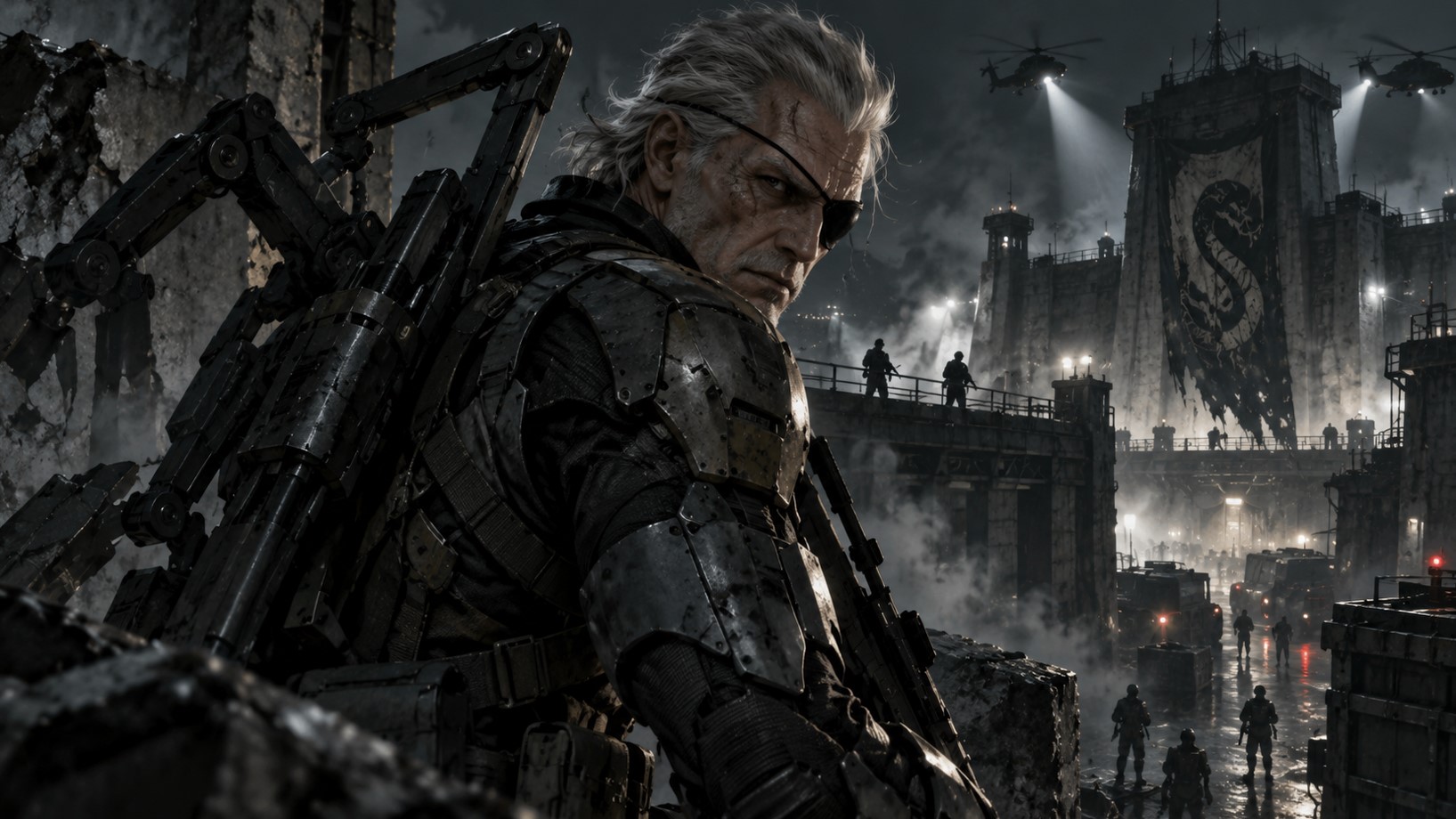
Solidus Snake: The Metal Gear Villain Who Was Right
Twenty-five years ago this November, a man in a white coat stood on top of Federal Hall in Manhattan, waved four mechanical tentacles around, and told a confused teenager that he was going to free humanity by destroying the systems that decide what it’s allowed to know. Everyone thought he was the bad guy. He was the bad guy. He was also, in a way that’s become almost uncomfortable to sit with, mostly correct.
Metal Gear Solid 2: Sons of Liberty turned 25 in November, and the timing is odd. Konami just put Master Collection Vol. 2 out on August 27, finally dragging Metal Gear Solid 4 off the PlayStation 3 after eighteen years. There’s a fan survey floating around asking which games should get the Delta treatment next, with Sons of Liberty sitting right there on the list. And the themes MGS2 was mocked for in 2001 – information filtering, synthetic consensus, machines deciding what’s true – are now just, you know, Tuesday.
So let’s talk about Solidus Snake properly. Not the boss fight. The character.
The Name Is the Joke, and the Joke Is the Character
Start here, because it tells you everything. In metallurgy, the solidus is the line below which a material is completely solid. The liquidus is the line above which it’s completely liquid. Between them sits a mushy zone – not one thing, not the other.
Solid Snake. Liquid Snake. And Solidus, who sits in between and belongs to neither.
There’s a second reading too. A solidus is the slash character – the “/” that separates two options. Which is exactly what he is: the divider standing between his brothers, defined entirely by what’s on either side of him.
Kojima’s naming has never been subtle, but this one’s genuinely elegant. The third clone got the name that means “stuck between categories,” and then spent an entire game failing to be a category.
From the Oval Office to a Rooftop
Here’s the part that still makes new players sit up. Solidus was the President of the United States.
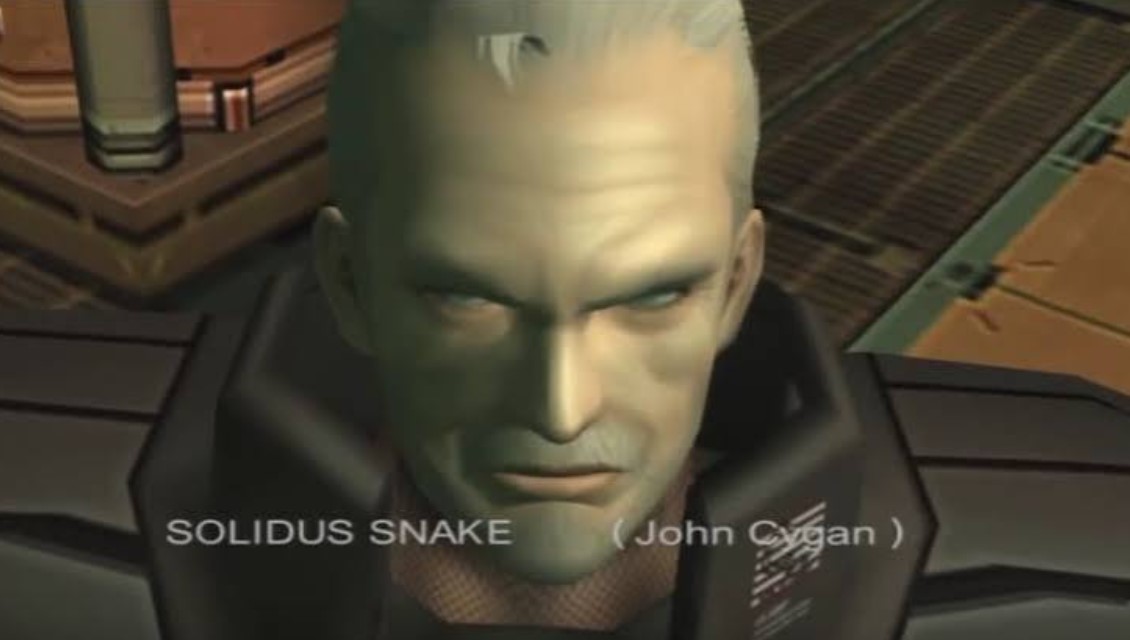
| Dossier | Detail |
|---|---|
| Public identity | George Sears, 43rd President of the United States |
| Origin | Third product of Les Enfants Terribles, the Big Boss cloning project |
| Genetic status | The “perfect” clone – neither dominant nor recessive traits |
| Brothers | Solid Snake and Liquid Snake |
| Main appearance | Metal Gear Solid 2: Sons of Liberty, 2001 |
| Affiliation | Leader of the Sons of Liberty |
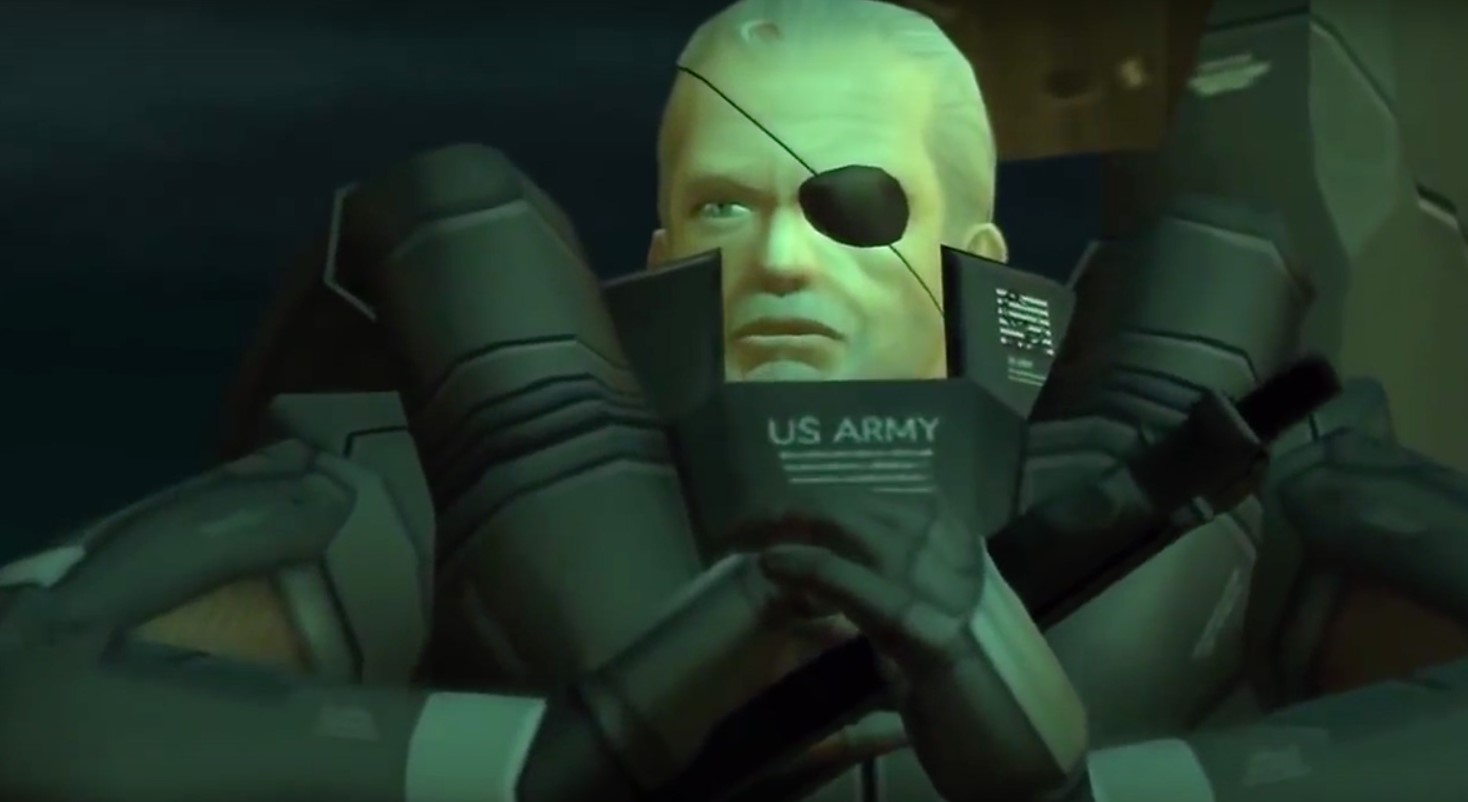
| Equipment | Powered exoskeleton, four tentacle arms, twin high-frequency blades |
| English voice | John Cygan |
| Japanese voice | Banjō Ginga |
Sit with that first row. The series that gave us a psychic in a gas mask and a sniper with photosynthesis also gave us a sitting American president who was a secret clone of the world’s greatest soldier – and then had him leave office under a cloud after Shadow Moses, replaced by a man who turned out to be just as hollow.
Solidus wasn’t removed because he was corrupt. He was removed because he stopped being useful to the people who actually run things. That’s the whole thesis of MGS2 in one biographical footnote.
The exoskeleton matters too. Unlike Solid and Liquid, Solidus was engineered with an accelerated aging pattern, which left him physically compromised in ways the suit compensates for. The tentacles aren’t a power fantasy. They’re a crutch that happens to also be terrifying.
Three Brothers, Three Different Failures
The Snake brothers are usually flattened into “hero, villain, other guy.” That’s a disservice to all three.
| What He Wanted | What Drove Him | How It Ended | |
|---|---|---|---|
| Solid Snake | To be left alone | Duty he never asked for | Kept getting pulled back in |
| Liquid Snake | To prove he wasn’t inferior | Resentment toward his own genes | Consumed by the grudge |
| Solidus Snake | To free people from invisible control | Guilt, ambition, and a hunger for legacy | Killed by the child he raised |
Liquid’s entire personality is an argument with a lab report. Solid spends four games trying to stop being a weapon. Solidus is the only one whose motivation points outward – he’s not fighting his own DNA, he’s fighting a system.
Which is precisely what makes him harder to dismiss. Liquid wants to win. Solidus wants to change something.
What He Actually Wanted?
His stated goal, delivered in the game’s final stretch, breaks down roughly like this:
- Expose the Patriots – the shadow group steering American policy from behind every institution.
- Destroy their control over digital information, specifically the censorship and curation layer they’d built.
- Restore the original intent of the nation’s founding, as he understood it.
- Be remembered – he says it outright, and it’s the crack in his whole argument.
- Give people back the ability to pass on their own truth rather than an approved version of it.
Read that list without knowing who said it and it sounds like a manifesto you’d see quoted approvingly online. Read it knowing he ran a child soldier unit in Liberia and orchestrated a nuclear-armed hostage crisis in Manhattan, and it gets complicated fast.
That’s the point. Kojima gives the most articulate political argument in the game to a man who cannot be trusted with it.
Why Solidus Snake Reads Differently in 2026
In 2001, critics called the ending incomprehensible. A famous stretch of the finale involves an artificial intelligence explaining that its job is to sort through an overwhelming flood of digital information and decide which parts deserve to survive – because without that filtering, context collapses and nothing means anything.
Twenty-five years later, that is a description of a normal afternoon.
Solidus’ argument is essentially that the filter itself is the tyranny. That whoever decides what gets remembered decides what’s real. He’s not wrong about the mechanism. He’s wrong about himself as the solution – his answer is to seize the filter rather than dismantle it, which he never quite admits.
The game is careful here, and this is the bit people miss. Solidus isn’t presented as a prophet. He’s presented as a man whose diagnosis is sharp and whose prescription is self-serving. The AI he’s fighting even points this out. He wants to be the one remembered for fixing it.
That vanity is the whole tragedy. A purely selfless Solidus would have been insufferable. A purely evil one would have been forgettable.
The Raiden Problem
Now the ugly part.
Before he was president, Solidus ran a unit of child soldiers during the Liberian civil war. One of those children was a boy called Jack, who earned a reputation and a nickname you don’t want attached to a ten-year-old. Solidus took him in afterward. Raised him. In every functional sense, adopted him.
Then, decades later, engineered a crisis specifically designed to put that same young man in the middle of it – as a test subject, in a simulation of Shadow Moses, being shaped into a copy of Solid Snake.
Their final confrontation isn’t a hero fighting a villain. It’s a son fighting the man who made him, killed his parents, and is also the only father he’s ever had.
A few things worth holding in your head about that relationship:
- Solidus genuinely seems to care about Raiden, in the broken way a manipulator cares about a favorite project.
- Raiden’s memories were tampered with, so his rage arrives before his understanding does.
- The fight settles nothing emotionally – Raiden wins and is left with no answers at all.
- It reframes the whole game, because MGS2’s real subject was never Solid Snake.
This is why the “Raiden bait-and-switch” discourse has aged so badly. People spent years angry that they didn’t get to play as Snake, when the entire structure was built to make you inhabit someone being molded into a legend by a man with an agenda. You weren’t supposed to be comfortable.
The Federal Hall Duel
Mechanically, it’s one of the purest boss fights in the series, and it holds up in the Master Collection version.
You’re on the roof of Federal Hall, with the statue of George Washington below and a burning Manhattan skyline behind. Solidus opens with both high-frequency blades. His tentacles let him grab you, throw you and cover ground absurdly fast. There’s no gadget solution here – it’s a sword duel with a man who is better at sword duels than you are.
Things that genuinely help:
- Block and counter rather than swinging first. His openings come after his combos, not before them.
- Keep moving in circles. Standing still lets the tentacles close distance and grapple you.
- Cut the tentacles when you get the chance – it reduces his reach and his mobility noticeably.
- Save your healing items for the second half. The fight escalates rather than staying flat.
- Watch the arena edges. Getting thrown off is a faster loss than getting cut down.
It’s one of the few Metal Gear bosses that doesn’t have a trick. No sniper duel gimmick, no controller port switching, no photosynthesis. Just two people with swords and a very long conversation about legacy happening between swings.
Where Else He Turns Up
Solidus appears in exactly one mainline game, which makes his footprint across the series surprisingly wide.
In Metal Gear Solid 4 – now finally playable outside the PS3, thanks to Master Collection Vol. 2 – his body becomes a plot point. The corpse everyone believed was Big Boss turns out to have been Solidus all along, having served as a decoy. Even in death he’s standing in for someone else. The name keeps doing its work.
In Metal Gear Solid Delta: Snake Eater, Konami slipped in a joke for the devoted. Hidden in the final boss arena at Rokovoj Bereg are three capturable snakes: Snake Solid, Snake Liquid and Snake Solidus. Actual reptiles. You can eat them. The series has never taken itself as seriously as its reputation suggests.
He’s also the reason a lot of people can’t let the Sons of Liberty era go. When Solid Snake turned up as a Rainbow Six Siege operator earlier this year, the design fans immediately clocked was his MGS2 look – the game everyone supposedly hated on release is now the visual shorthand for the whole franchise.
The Remake Question Nobody Can Answer
So where does this leave things?
Konami has had a very good couple of years with its back catalogue. Delta sold over a million copies on day one despite launch technical complaints. Master Collection Vol. 2 arrived August 27 across PS5, Xbox Series X|S, Switch, Switch 2 and Steam at $49.99, bundling MGS4, Peace Walker and Ghost Babel with screenplay books, a database and a soundtrack. The preservation gap on MGS4 – closed after eighteen years, largely because the PS3’s Cell architecture made porting a nightmare – is genuinely a big deal.
The company has also run a fan survey asking which entries deserve remakes, with essentially the whole series on the list. Sons of Liberty included.
But Konami has stayed deliberately quiet about what actually comes next. Producer comments have consistently framed future projects as dependent on how audiences respond to the current ones. That’s corporate for “we haven’t decided.”
Here’s my honest take on why an MGS2 remake would be harder than Delta was. Snake Eater is a Cold War spy story with timeless bones. Sons of Liberty is a game about the year 2001’s anxieties regarding the year 2009, made before social platforms existed, whose ending accidentally predicted the next quarter-century. Remaking it means deciding whether to update those references or preserve them as a period piece. Both options lose something.
And Solidus is the hinge. Get him wrong – make him a straightforward terrorist, trim his speeches for pacing – and the game becomes a mediocre stealth action title with a confusing ending. Get him right and you’ve got the most relevant story in Konami’s vault.
FAQ
Who is Solidus Snake?
The third clone from the Les Enfants Terribles project, publicly known as George Sears, 43rd President of the United States, and the main antagonist of Metal Gear Solid 2.
Is he stronger than Solid and Liquid?
He’s described as the most balanced of the three – neither dominant nor recessive traits – though he was engineered with accelerated aging that left him physically compromised.
What’s his connection to Raiden?
He commanded Raiden as a child soldier in Liberia, killed his parents, and then raised him. Raiden kills him at Federal Hall.
Why does he have tentacles?
They’re part of a powered exoskeleton that compensates for his physical condition while giving him extended reach in combat.
Does Solidus appear in any other games?
Only in MGS2 as a living character. His corpse features in a Metal Gear Solid 4 plot twist, and Delta hides a snake named after him.
Who voiced him?
John Cygan in English and Banjō Ginga in Japanese.
Is there an MGS2 remake coming?
Nothing confirmed. Konami has surveyed fans about future remakes with Sons of Liberty on the list, but has announced no plans.
He Wanted to Be Remembered, and That’s Exactly What Happened
There’s a bleak irony at the center of this character that I don’t think Kojima gets enough credit for. Solidus’ deepest motivation isn’t freedom. It’s the fear of being erased – of dying as a footnote in someone else’s story, a clone remembered only for being neither Solid nor Liquid. He says it himself. He wants to leave proof he existed.
And then he dies on a rooftop, killed by his own adopted son, and his body gets recycled as a stand-in for Big Boss. The universe grants him precisely the fate he was terrified of.
Except it didn’t, quite. Twenty-five years on, with MGS4 finally on modern hardware and Konami quietly asking people which game to rebuild next, the villain everyone found confusing in 2001 has become the one the series can’t stop being about. He got his legacy. He just had to lose everything to get it.
Not bad for the slash between two other names.
P.S. If this gave you more than the usual character-wiki copy-paste, pass it around on X, Reddit or wherever your Metal Gear people congregate – independent writing survives on exactly that kind of hand-to-hand distribution, no algorithm required. Bookmark it too, because if Konami ever confirms a Sons of Liberty remake we’ll be expanding this piece rather than starting a new one. And should creative or commercial collaboration be on your mind, contact the T-Minus team directly – unlike the Patriots, we’ll tell you who we are.