
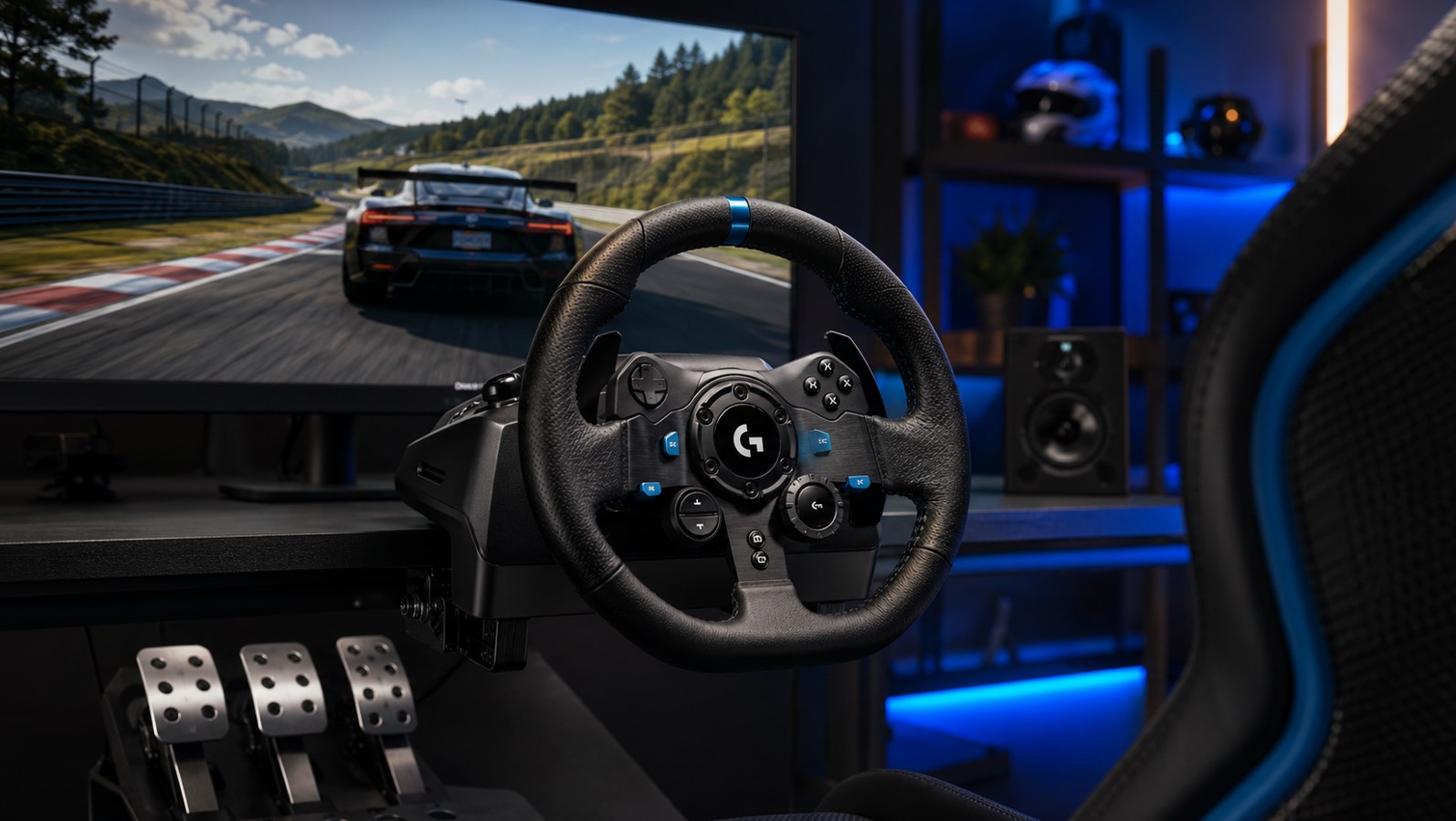
Logitech Wheel Lineup: Your Gateway to Sim Racing
There’s a moment every sim racing fan remembers: the first time a force feedback wheel yanks in your hands as your car’s rear steps out mid-corner. Suddenly a driving game becomes driving. And for a huge chunk of players, the wheel that delivered that moment had a Logitech badge on it. For over a decade, a Logitech wheel has been the default first step into sim racing. But here’s where it gets confusing. G29? G920? G923? G Pro? What’s the difference, and which one deserves your money?
That’s exactly what this guide untangles. Rather than a dry spec sheet, I’m going to take you on a tour of the entire Logitech wheel lineup, explain what genuinely separates each model, weigh in the community’s brutally honest opinions, and help you land on the right pick for your setup and budget. Whether you’re a total beginner clamping a wheel to a desk for the first time or eyeing a serious upgrade, this’ll steer you straight. Buckle up. Let’s go.
Meeting the Logitech Wheel Family
Before we compare anything, you need to know the players. Logitech’s racing wheel range breaks into two clear tiers, and understanding that split makes everything else click into place.
The lineup divides into the entry-level gear-driven wheels (the long-running G29, G920, and G923) and the premium direct-drive flagship (the G Pro). They’re built on fundamentally different technology, which is the single most important thing to grasp about the range.
Here’s the family at a glance:
- Logitech G29 – the PlayStation and PC entry-level wheel, a decade-long beginner staple.
- Logitech G920 – the Xbox and PC version of the same classic wheel.
- Logitech G923 – the newer entry-level model, adding TrueForce feedback; comes in Xbox and PlayStation variants (both work on PC).
- Logitech G Pro – the premium direct-drive flagship with 11Nm of force.
That console-specific split trips people up constantly, so let me be crystal clear: the G29 is for PlayStation and PC, while the G920 is for Xbox and PC. They’re otherwise nearly identical wheels. The G923 also comes in two versions – one for Xbox, one for PlayStation – and both work on PC. So step one in choosing any Logitech wheel is matching the model to your console. Get that wrong and it simply won’t work.
The G Pro is a different beast entirely, using direct-drive technology instead of the gears found in the cheaper models. We’ll dig into what that means shortly, but for now, just know it sits in a much higher price and performance bracket.
What Actually Makes a Logitech Wheel Feel Good
Let’s talk about the technology under the hood, because the force feedback system is what separates a great racing wheel from a glorified toy. This is where the real differences live.
Every Logitech wheel includes force feedback – the motorized resistance that lets you feel the car through the wheel. The entry-level G29, G920, and G923 all use a gear-driven system, producing around 2.2 to 2.4Nm of peak torque via a small motor connected to the drive shaft through a series of gears. It’s strong enough to feel how the car behaves on track, which is exactly what a beginner needs.
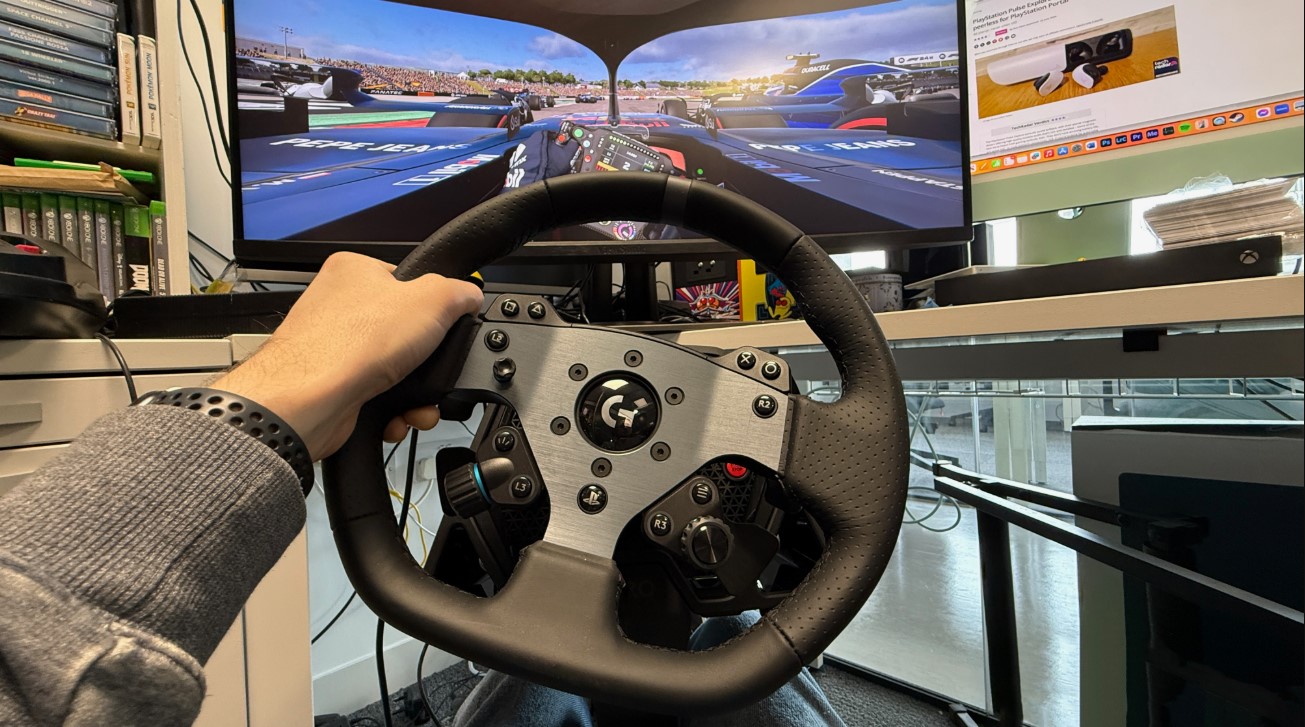
Here are the key feedback technologies to understand:
- Gear-driven force feedback – the G29/G920/G923 system; affordable and capable, but can feel slightly notchy.
- TrueForce – the G923’s headline upgrade, adding high-definition vibration tied to in-game audio and physics.
- Direct drive – the G Pro’s premium system, where the wheel mounts straight to the motor for smoother, stronger, more detailed feedback.
That TrueForce feature is the G923’s main claim over the older wheels. It connects directly to supported game engines, processing feedback thousands of times per second so the wheel vibrates based on in-game audio and physics. Rev your engine, and the wheel buzzes accordingly. It’s a genuine immersion boost – in supported titles. The catch, which the community stresses, is that it only shines in games that specifically support it.
The G Pro’s direct drive is the real leap. By mounting the wheel directly to the motor with no gears in between, it delivers up to 11Nm of force with incredibly smooth, low-latency, detailed feedback. This is the technology serious sim racers crave, and it’s why the G Pro commands a premium price. The difference between gear-driven and direct drive is night and day once you feel it.
The Great Debate: G29 vs G923
Here’s the argument that dominates every Logitech wheel discussion, and it’s worth settling because it directly affects your wallet. Should you buy the older G29 (or G920) or the newer G923? The community has strong, well-reasoned opinions here.
On paper, the G923 is the better wheel. As reviewers note, from a design, functionality, and performance perspective, it’s a genuine improvement over the G29/G920, thanks to TrueForce and a much-improved brake pedal. The G923’s brake pedal uses a progressive spring that’s stiffer and more realistic, mimicking the pricier load-cell pedals that sim racers covet – a real upgrade over the older wheels’ soft, sometimes problematic rubber block.
But here’s where the community pushes back hard:
- The G29/G920 is often much cheaper – frequently available new or second-hand at a significant discount.
- Performance is nearly identical – the core wheel and force feedback are largely the same.
- The brake mod exists – players have long modded the G29 brake with a stiffer spring for around $35, replicating the G923’s feel.
- TrueForce is divisive – some find it a meaningful immersion boost, others call it a “mediocre haptic feed” not worth the premium.
That’s the crux of the debate. As one community member put it, the G923 is essentially a G920 with a rev limiter, a few extra buttons, TrueForce, and a different brake spring – otherwise the same wheel. Many argue that doing the ~$35 spring mod on a cheaper G29 or G920 gets you 90% of the way there for far less money. Others counter that not having to disassemble your pedals, plus the bonus features, is worth the modest price gap.
The honest verdict from the community in 2026? The G29 often remains the smarter buy – cheaper, near-identical performance, and widely available second-hand, making the value difference enormous. But if you want TrueForce and the better brake out of the box with zero fuss, the G923 is a perfectly reasonable pick, especially on sale.
When to Reach for the G Pro?
Let’s talk about Logitech’s flagship, because it represents a completely different proposition from the entry-level wheels. The G Pro isn’t for everyone, but for the right racer, it’s spectacular.
The Logitech G Pro is a direct-drive racing wheel delivering up to 11Nm of force – roughly five times the torque of the entry-level gear-driven wheels. That translates to dramatically smoother, stronger, and more detailed force feedback. It also features TrueForce, magnetic gear-shift paddles with contactless hall-effect sensors, and the kind of build quality that justifies its flagship status. When it’s been on sale, it’s dipped to around $806 from a $1,000 list price, which tells you the bracket it plays in.
Here’s who the G Pro suits:
- Serious sim racers – those who race often and want maximum realism and precision.
- Competitive players – the low-latency direct drive offers a genuine performance edge.
- Upgraders with budget – racers moving up from an entry-level wheel who feel its limits.
- Long-term investors – those wanting a wheel that won’t need replacing as they improve.
The key question with the G Pro is simply whether you need it. For a beginner or casual player, it’s massive overkill – you’d be paying flagship money for performance you can’t yet exploit. But for a dedicated sim racer chasing every tenth of a second and craving true realism, the direct-drive feel is transformative. It’s the difference between “this is fun” and “this feels like driving.”
One honest note: at the G Pro’s price point, it enters fierce competition with direct-drive rivals from brands like Moza and Fanatec, and the community debate over which flagship reigns supreme is a whole other rabbit hole. But as a Logitech ecosystem flagship, the G Pro is a genuinely excellent direct-drive wheel.
How Logitech Stacks Up Against Rivals?
No honest Logitech wheel guide ignores the competition, because the entry-level landscape has shifted a lot. Logitech no longer has the budget segment to itself, and knowing the alternatives helps you make a smart choice.
The market has become far more competitive, especially at the entry level. Here’s how the community sees the key matchups:
- vs Thrustmaster T128 – the T128 gives better force feedback on a tight budget, while Logitech offers better build quality and pedals.
- vs Thrustmaster T248 – the T248’s hybrid belt system gives more torque and stronger feedback, though many prefer Logitech’s build and rim.
- vs Moza R3/R5 – entry-level direct-drive bundles from Moza are increasingly affordable and outclass gear-driven wheels in raw power and precision.
- vs older Logitech wheels – some longtime fans argue the classic G25/G27 were built tougher than the current lineup.
That Moza comparison is the big story of 2026. Affordable entry-level direct-drive wheels have arrived, and they change the calculus. For not much more than a G923, you can sometimes get into a direct-drive setup that’s simply in another league for feedback quality. Several community members now recommend looking hard at Moza before defaulting to Logitech, especially if force feedback quality is your priority.
That said, Logitech retains real strengths: consistent build quality, excellent broad game compatibility, easy plug-and-play setup, strong software in G HUB, and that all-in-one bundle convenience (wheel, pedals, sometimes a shifter).
For a beginner who wants a proven, hassle-free package that works across tons of games, a Logitech wheel remains a genuinely safe, sensible choice. Just go in aware of the alternatives.
Choosing Your Logitech Wheel: A Quick Decision Path
Let me pull everything together into a clear decision path, because with all these options, you deserve a straightforward answer. Here’s how to pick your Logitech wheel based on who you are.
Walk through these scenarios to find your match:
- Total beginner on a tight budget – hunt for a G29 (PlayStation/PC) or G920 (Xbox/PC) on sale or second-hand; unbeatable value for your first wheel.
- Beginner wanting the newest features out of the box – the G923 with TrueForce and the better brake pedal, ideal when it’s discounted.
- Value-focused tinkerer – buy a cheap G29/G920 and do the ~$35 brake spring mod yourself for near-G923 feel.
- Serious/competitive sim racer with budget – the G Pro direct-drive flagship, or seriously consider a Moza direct-drive rival.
- Immersion-focused player – TrueForce (G923 or G Pro) genuinely enhances supported games.
The overarching wisdom is this: match the wheel to your commitment level and console. If you’re dipping a toe into sim racing, a cheap G29 or G920 is a fantastic, low-risk entry that’ll teach you whether the hobby grabs you. If it does, you can always upgrade later. If you already know you’re serious, skipping straight to direct drive (the G Pro or a rival) saves you from buying twice.
And crucially, always check compatibility first. A G29 won’t work on Xbox, and a G920 won’t work on PlayStation. Confirm your platform, then shop the sales – Logitech wheels drop in price frequently, and patience often saves you a lot of money.
Nail those two things, and whichever Logitech wheel you choose, you’ll be gripping the start of a genuinely thrilling hobby.
The Final Lap
So there’s your complete tour of the Logitech wheel lineup. From the veteran G29 and G920 that introduced a generation to sim racing, through the feature-added G923 with its TrueForce and improved brake, up to the premium direct-drive G Pro, there’s a Logitech wheel for nearly every racer and budget. The trick is matching the model to your platform, your commitment, and your wallet.
My honest advice? Beginners should grab a discounted G29 or G920 – the value is unbeatable and the performance is nearly identical to the pricier G923. If you want TrueForce and the better pedal without tinkering, the G923 on sale is a fine choice. And if you’re a serious racer with the budget, the direct-drive G Pro is transformative, though it’s worth weighing against increasingly strong rivals like Moza. Whatever you pick, confirm your console compatibility and wait for a deal.
A racing wheel changes sim racing from a game into an experience, and Logitech has earned its reputation as the genre’s most trusted on-ramp. Pick the model that fits your journey, mount it to your desk or rig, and feel your favorite tracks come alive through your fingertips. The green light’s on. Time to race.
P.S. Here’s your victory-lap thank-you, taken at full throttle: if this guide helped you steer toward the right wheel, share it across your social feeds so fellow racers don’t spin out on the G29-versus-G923 confusion, and pin it to your bookmarks like a perfect racing line you’ll want to hit again before your next purchase. Every share is basically a slipstream boost that keeps our team’s guides out front of the pack. And if you’re seeking creative or commercial collaboration, the T-Minus team is one message away – reach out directly, and let’s cross the finish line together.