

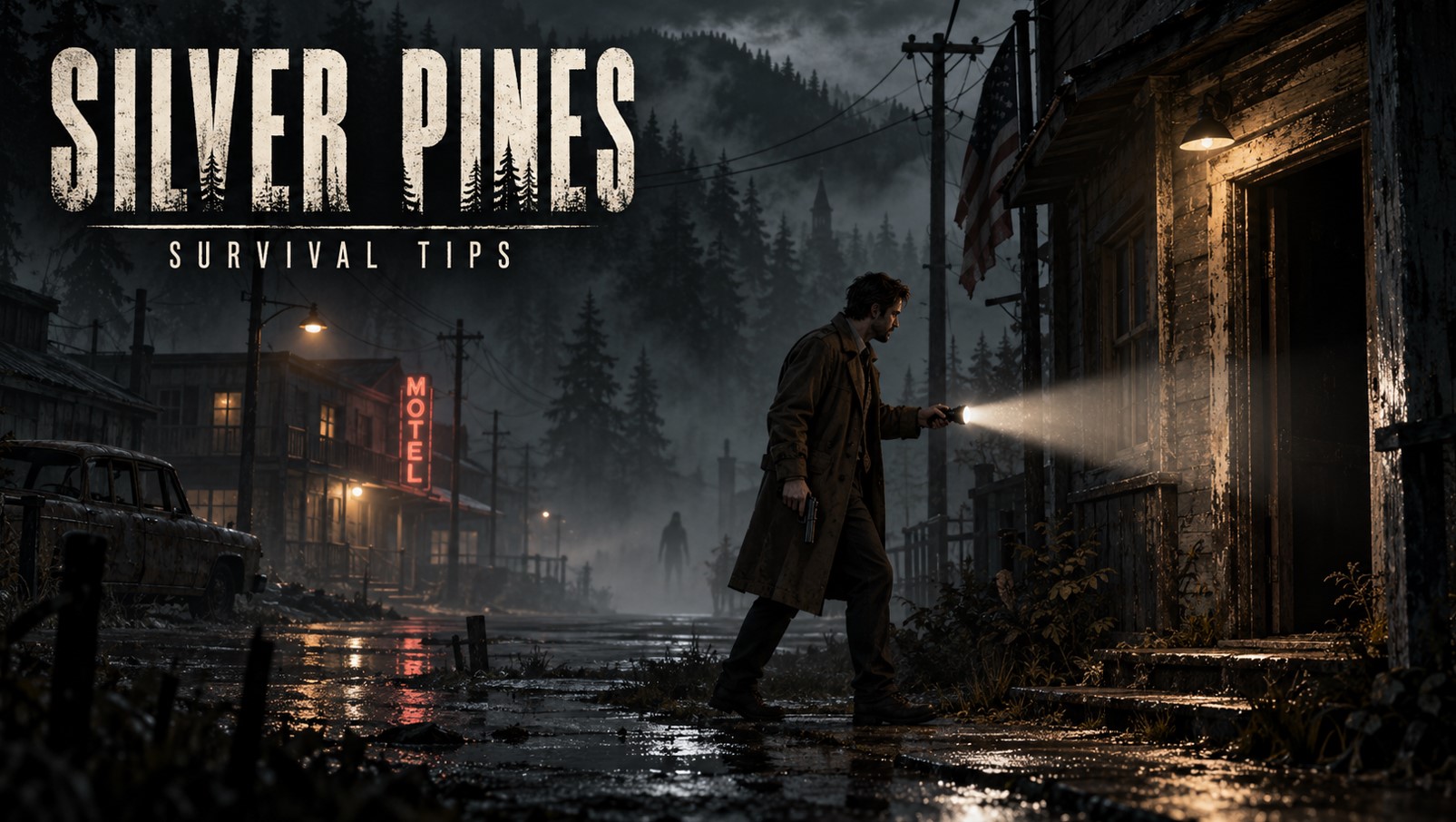
Silver Pines Tips Start With One Fact: There Is No Health Bar
Wych Elm’s survival horror does not have a number anywhere you need one. No health bar. No ammo counter you can trust at a glance. No stamina meter. No tooltip explaining why the door you are standing at will not open. What it has instead is a vocabulary. A Polaroid photograph that tells you how close to death you are. A yellow flicker on a weapon icon that means your rifle is not ready. Stacked wooden pallets that mean a ledge is reachable. A screen that reddens as you bleed.
Learn that vocabulary and Silver Pines is a fair, legible game. Miss it and you will die in a diner wondering what went wrong.
So rather than a list of tricks, these are the five questions the game refuses to answer with a number, and how to get the answer anyway. Then the three permanent upgrades, the optional content worth skipping, and the endings.
For context: Silver Pines launched on October 8 at $24.99, from Wych Elm and Team17, across PS5, Xbox Series, Switch, Switch 2 and PC. You play Red Walker, a private investigator looking for a vanished musician named Eddie Velvet in a hand-painted, rotoscoped town that owes a great deal to Twin Peaks.
Question One: How Hurt Am I
There is no health bar, and this is the single most important thing a new player does not know.
Your condition is written under your Polaroid in the inventory, on a scale running from Fine down to Critical. That is your health readout, and you have to go looking for it. The ambient signal is that the screen reddens as you take damage – subtle at first, unmistakable by the time you are in trouble.
Check the Polaroid after every fight. Not during – after. Players who treat the red tint as the only indicator consistently misjudge how much damage they have left in them, because the tint reads differently depending on how dark the room is.
Healing runs on a short crafting chain:
- Green Herbs restore health and can be eaten raw, though they work more slowly that way.
- A Green Herb plus a bottle makes a Healing Tonic.
- A tonic plus another Green Herb makes a stronger tonic.
- Other items can be combined into tonics to change what they do.
- Medkits involve a minigame, which makes them a poor emergency option.
That last point reshapes your loadout. Keep a tonic for the moment a fight goes wrong, and save medkits for the quiet corridor after it, because fumbling a minigame while something chases you is how a Critical becomes a reload.
Question Two: Can I Shoot Again
Ammo is scarce, melee weapons wear out, and the game will not count either for you in a way you can read mid-fight.
The Shotgun and the Bolt-Action Rifle have to eject a shell before firing again, and a yellow alert on the weapon indicator is how you know. That yellow flash is your rate-of-fire readout. Firing into it does nothing except waste the second you needed.
The rest of the combat grammar:
- Body shots over headshots. Headshots do not reliably help here, which runs against instinct from every other game in the genre.
- Basic melee beats charged overhead swings. The charged attack leaves you exposed for longer than the extra damage justifies.
- Stomp downed enemies. Sprint to a fallen enemy and press the stomp prompt. An enemy you walk away from is an enemy you fight twice.
- Red propane tanks are free damage. Shoot or strike one and then retreat before it goes off.
- A broken melee weapon does almost nothing. When your bat is finished, run rather than swinging.
- Dodge taps backward; dodge with forward held goes past. Holding forward and dodging attempts to slip around an enemy rather than retreating from it.
And the overriding rule, which the game’s resource design enforces: most fights are optional and should be declined. Enemies follow you through doors and between screens, so disengaging is not always clean – but sprinting does not drain stamina, which means running is always affordable in a way fighting is not.
Silver Pines Tips for Reading the Environment
Metroidvania progression here is tool-gated, and the game marks every obstacle with the tool that solves it. Once you know the pairings you stop wandering.
| Obstacle | What Opens It |
|---|---|
| Plastic sheeting | Boxcutter or knife |
| Wooden barricades and boxes | Crowbar |
| Cracked concrete | Sledgehammer |
| Dark rooms and the sewers | Flashlight |
| Ventilation grates | A gunshot |
| Higher ledges | Stacked wooden pallets below them |
Stacked pallets are the game’s handwriting for “you can climb here.” Once you notice that, a lot of the town stops looking like scenery.
Shoot ventilation grates. Many of them open hidden routes or hide supplies, and there is no visual difference between a decorative grate and a useful one until you put a round through it.
The tool that ties it together is the Polaroid. Photograph every locked door and blocked passage you cannot deal with yet. Photos attach to your map, which turns the backtracking problem – the thing that sinks most Metroidvania runs – into a list. You can delete photos you no longer need.
Two movement details worth internalising early: you can sprint straight through any door that is already open to you by running at it and pressing the interact button, and ledge grabs require standing in a precise spot, with gaps often wider than they look. Missing a jump into water will generally set you back to an earlier point with some damage.
Also: broken tools still work for traversal. A ruined crowbar will not fight, but it will still pry. Never throw one away.
Question Three: Am I Hidden
Stealth in Silver Pines is binary and it is based entirely on light.
Enemies cannot see you in the dark. Turn lights off, crouch, and walk past things you cannot afford to fight. This is the most reliable survival tool in the game and it costs nothing.
The complications:
- Standing up to work a lock can alert something nearby. Clear the path before you start fiddling with a door.
- Dodging near an enemy can alert it too, so the escape move can also be the thing that gets you caught.
- Your flashlight burns batteries. Turn it off whenever you are not actively looking at something.
That last one creates the game’s central tension and it is deliberate. The flashlight is what lets you see and interact with objects in dark areas, including the sewers – and the dark is also what hides you. You are constantly trading visibility for safety, with a battery meter ticking down behind both.
Question Four: Can I Afford It
Silver Pines has money, and money is mostly for staying alive rather than getting stronger.
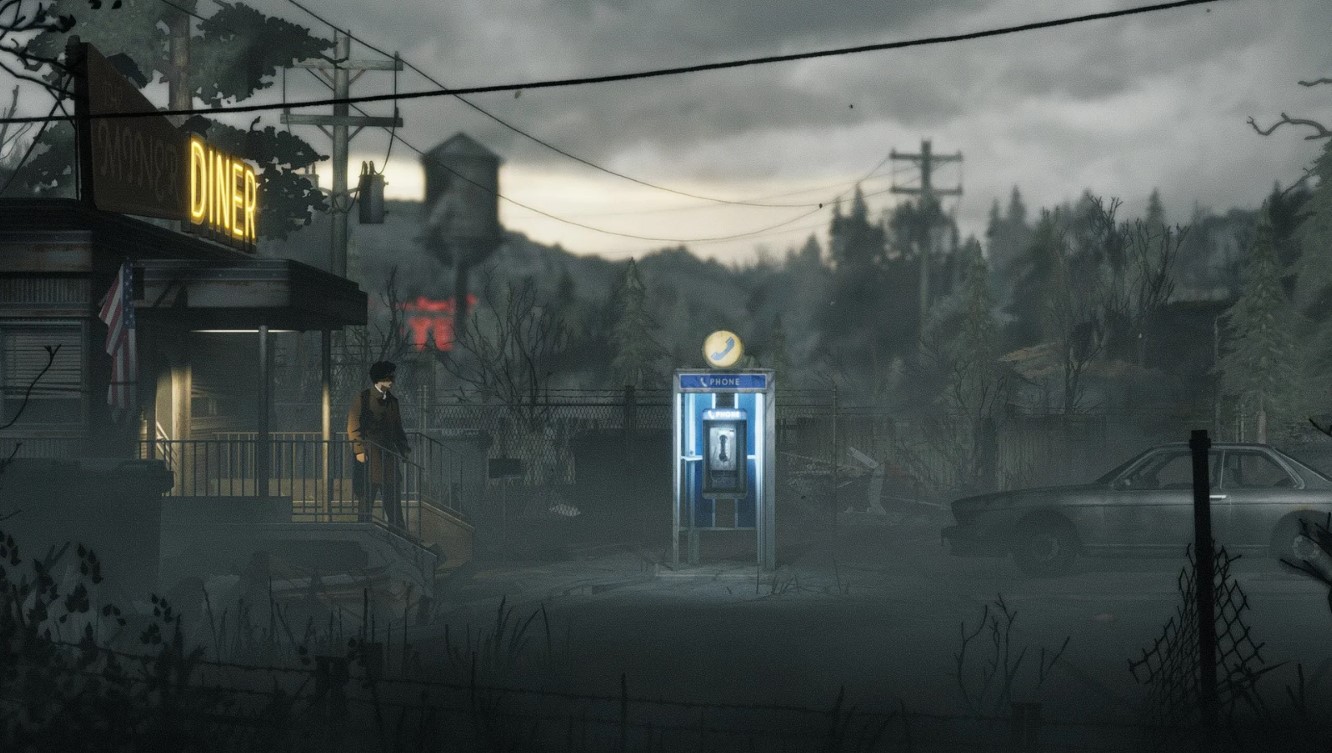
Payphones are the save points, and each one needs a coin. This makes coins the most valuable currency in the game.
The habit that pays for itself: check the coin return on every new payphone. Many of them have a coin sitting in there the first time you look, which is effectively a free save.
Where everything else comes from:
- Duffel bags and large yellow bags hold resources. Search every one.
- Hanging coats and purses hold money and keys.
- Car trunks are worth opening constantly, and many need no special tool.
- Vending machines are a legitimate place to spend, including on keys.
- Newspapers are a trap. They offer limited lore for real money. Keep that cash for payphones and vending machines instead.
Then there is the quieter budget: inventory space. Press the move and rotate controls to arrange things, and know that you can drop items temporarily without losing them – useful when you have found something large and need to shuffle. The Combine menu highlights compatible items in blue, which is how you discover crafting pairs without a recipe book, and an inventory trunk near a payphone also allows combining.
Carry duct tape and spare parts. Repairs are the difference between a melee weapon that lasts three areas and one that lasts one.
The Three Permanent Upgrades
Almost everything in Silver Pines is consumable. These three are not, and all three are easy to walk past.
Coffee makers permanently raise your maximum stamina. Drink from every single one you find. Dodging and melee both drain stamina, so this is a direct and permanent increase in how much combat you can survive. There is no reason to ever skip one.
Yellowish-brown shoulder bags add two inventory slots each. In a game where space is the limiting factor on what you can carry out of an area, these are worth detouring for ahead of almost any other pickup.
A second Memento slot comes from the Green Bird Statue. Mementos give passive bonuses – more stamina, reduced damage taken – and you start with only one slot. Find all four Green Bird Statue pieces, combine them, and consume the result to open the second. Two passive bonuses instead of one is a larger power swing than any weapon you will find.
What to Skip When Supplies Are Low
Three pieces of optional content, graded honestly, because the game punishes overextension.
- The Movie Theater is worth it. A $20 key from a vending machine opens the second floor, where the Nail Gun is waiting. A weapon for twenty dollars and a short detour is the best-value optional content in the town.
- The Chinese Cargo Ship is for completionists. Solving the control-panel puzzle opens an optional and genuinely difficult boss whose main reward is a Memento. Worth doing if you are collecting, skippable if you are surviving.
- The Outboard Motor is a judgement call. Repairing it enables boat travel between places you have already been, which is convenient – but it costs time and resources you may need elsewhere. Weigh it against where you are in your supply situation rather than taking it automatically.
When your supplies are thin, the correct answer is always the main path. The town is not going anywhere.
Silver Pines Tips for the Endings
Spoilers for the structure of the finale from here, though not for the story.
There are three endings, and the single most important thing to know is procedural: save at the payphone before you reach Eddie. Doing that lets you reload and see all three without replaying the game.
| Ending | What It Takes | What It Grants |
|---|---|---|
| Leave | Kill Eddie Velvet | The Switchblade |
| Rest | Spare Eddie after opening the Ring Box with all five Stars, pick Leave, then place both Gold Rings in the Rabbit Hole stage dents | The Reusable Repair Kit |
| Live | Spare Eddie, collect all 25 Mementos, and have Drew burn them in the furnace shack | The Omega Rifle |
Two things stand out from that table. The Live ending requires all 25 Mementos, which makes it a full-collection run rather than a late decision – if you want it, you need to know from early on. And every ending grants a reward that carries forward, which means the endings double as New Game Plus rewards as much as narrative conclusions.
If you are playing once and want the fullest version, the Mementos are the thing to be deliberate about from your first hour. Everything else about the endings can be decided at the payphone.
FAQ
Does Silver Pines have a health bar?
No. Your condition appears under your Polaroid in the inventory, running from Fine to Critical, and the screen reddens as you take damage.
How do you save in Silver Pines?
At payphones, each of which requires a coin. Check the coin return at every new payphone, as many hold one on first inspection.
How do you get more inventory space?
Find yellowish-brown shoulder bags, which add two slots each. You can also drop items temporarily without losing them to rearrange.
What permanently makes you stronger?
Coffee makers raise maximum stamina permanently, shoulder bags add inventory slots, and combining four Green Bird Statue pieces opens a second Memento slot.
Should you aim for headshots?
No. The community guidance is body shots, since headshots do not reliably help. The Shotgun and Bolt-Action Rifle also need to eject a shell between shots, shown by a yellow alert on the weapon indicator.
How do you sneak past enemies?
Enemies cannot see you in the dark, so turn off lights, crouch and move through. Be aware that standing up to work a lock or dodging nearby can still alert them.
How many endings are there?
Three – Leave, Rest, and Live – granting the Switchblade, the Reusable Repair Kit and the Omega Rifle respectively. Save at the payphone before reaching Eddie to see all three.
Learning to Read the Town
What makes Silver Pines worth the effort is that none of this is hidden. It is all right there, just not written in digits.
The Polaroid under your inventory is a health bar. The reddening screen is a damage warning. The yellow flicker is a reload indicator. Stacked pallets are a climb prompt. A blue highlight in the Combine menu is a recipe. A coin in a payphone return is a free save. Wych Elm built a complete information system and then refused to put a single HUD element on screen for any of it, which is exactly the right instinct for a game about a man walking into a town that will not explain itself either.
Which means the learning curve here is not difficulty, it is literacy. The first two hours are hard because you are reading a language you do not speak yet. Around the point where you start photographing locked doors without thinking about it, checking coin returns by reflex, and drinking every coffee you pass, the game turns from punishing into tense – which is what it was always trying to be.
Drink the coffee. Photograph the doors. Check the coin return.
Found your way out of the diner yet? Share this, bookmark it, and go drink every coffee in that town like your stamina depends on it – because it does. If creative or commercial collaboration brought you here, the T-Minus team is one message away.